
Legionella written scheme: what UK dutyholders must have
A legionella written scheme is the document that turns a risk assessment’s findings into a working system of controls, checks and named responsibilities for a water system. You need one if your legionella risk assessment finds a reasonably foreseeable risk that can’t be designed out. Under ACOP L8, that’s not optional guidance. It’s the benchmark the Health and Safety Executive (HSE) expects every dutyholder to meet, with HSG274 supplying the technical detail behind it.
If you’re checking whether your site needs one, work through this in order:
Commission or review a legionella risk assessment for every relevant water system.
Ask whether the risk could reasonably be removed by design (dry cooling instead of a wet tower, for instance).
If design alone won’t eliminate the risk, prepare, implement and keep a written scheme of control.
Many commercial buildings have water systems that fall into this category, be it a calorifier, a cooling tower or a stagnant pipe run behind a refurbished floor.
Key Takeaways
A legionella written scheme becomes legally required once a risk assessment finds a foreseeable risk that design alone cannot remove, and it must name responsible persons, monitoring frequencies and remedial actions to meet ACOP L8’s benchmark.
Point | Details |
Know the trigger | A written scheme is required once your risk assessment finds a risk that can’t be designed out. |
Cover the minimum contents | Include a schematic, control methods, monitoring frequencies, remedial actions and named responsible persons. |
Keep records for five years | HSE guidance expects monitoring and maintenance records retained for at least five years as evidence. |
Review after every trigger | Update the scheme after system changes, outages, test failures or at least annually. |
Get professional support | Bespoke Compliance Solutions drafts and implements written schemes, from risk assessment through to training and ongoing monitoring. |
Table of Contents
What counts as a legionella written scheme?
A written scheme is the operational manual for controlling legionella on a specific site. It’s distinct from the risk assessment: the assessment identifies where the hazards sit and how severe they are, while the scheme sets out exactly what gets checked, how often, by whom and what happens when a check fails. The HSE’s guidance on what you must do treats these as two separate but linked documents. One tells you the problem. The other proves you’re managing it.
That distinction trips up a lot of facilities teams. A risk assessment sitting in a folder somewhere doesn’t demonstrate compliance on its own. Inspectors want to see the scheme in daily use, with monitoring frequencies logged and remedial actions completed on schedule, not just planned.
When does UK law require a written scheme?
ACOP L8 applies wherever an employer or a person in control of premises has water systems that could create a reasonably foreseeable legionella risk that design cannot avoid. That covers a wide swathe of UK property types, and the sectors named specifically in HSE guidance include:
Offices, retail units and other commercial premises with hot and cold water systems
Healthcare settings, including hospitals and care homes, where vulnerable occupants raise the stakes considerably
Educational sites with halls of residence, sports facilities or older plumbing
Housing associations managing communal water systems across multiple blocks
Hotels, leisure centres and any site with cooling towers, spa pools or spray systems
Prevention by design comes first. Replacing a wet cooling tower with a dry air-cooled system, for example, can remove the hazard entirely rather than manage it. Where that isn’t reasonably practicable, a scheme becomes mandatory. ACOP L8 isn’t primary legislation, but in enforcement terms it carries real weight: if you deviate from it, you have to demonstrate your alternative gives at least equal protection. Most dutyholders don’t bother trying. They follow the code.
What must a written scheme include?
HSE guidance and HSG274 are specific about the minimum content. A scheme missing any of these elements is unlikely to survive scrutiny during an inspection or after an incident.
A schematic diagram showing the water system’s layout, including tanks, calorifiers, dead legs and outlets
Clear description of safe and correct operation for the system as designed
The specific control methods in use (temperature control, biocide dosing, filtration)
Monitoring checks and their frequencies
Predefined remedial actions for when checks fail
Named responsible persons and a note of their competencies
Recordkeeping requirements, including how long records are retained
The schematic is worth dwelling on. It’s the single most common inspection failure, because pipework changes, refurbishments and new outlets rarely make it back onto the diagram. An out-of-date schematic means nobody can say with confidence where the sentinel points actually are, or whether a newly capped-off pipe has become a dead leg nobody’s testing.
Sentinel points are the taps and outlets furthest from and closest to the water source, chosen because they represent the extremes of temperature and stagnation risk. HSG274’s technical appendices give worked examples of how to select them in hot water systems, and they’re the logical starting point for any monitoring schedule.
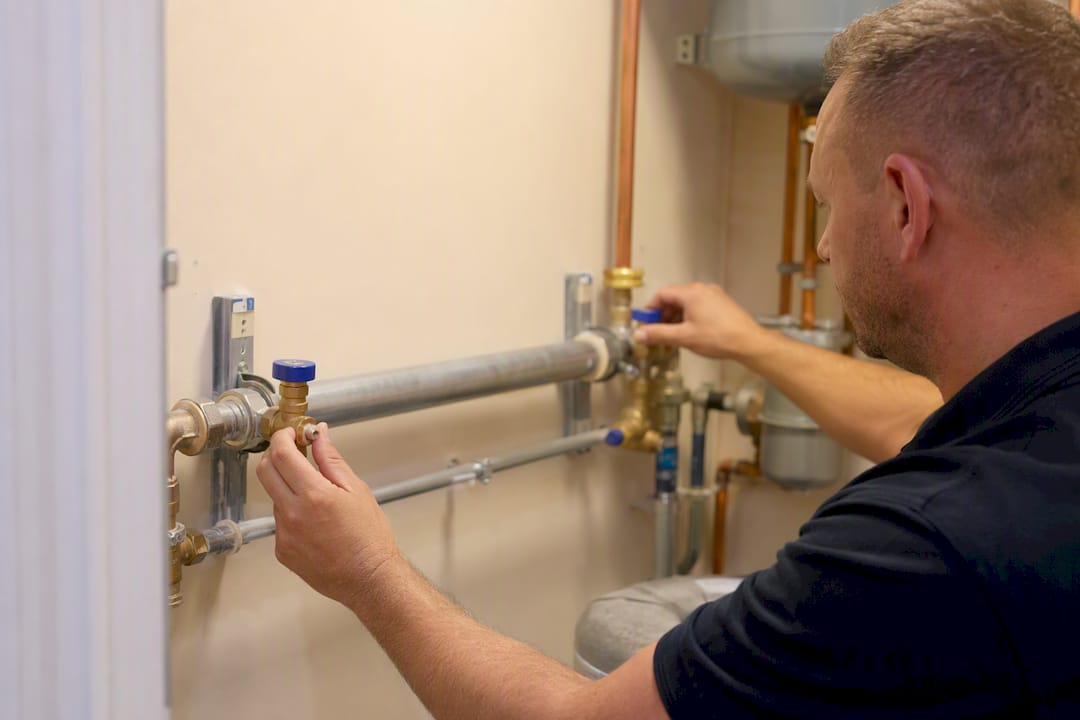
Pro Tip: Walk the schematic against the actual building before you finalise a scheme. It takes an afternoon, and it catches the dead legs and unlabelled outlets that written descriptions always miss.
Monitoring and maintenance records need to be kept for at least five years as evidence of ongoing control. Anything less, and you can’t show an inspector a credible history of management.
Who is responsible for the scheme?
The dutyholder, typically the employer or the person or organisation in control of the premises, carries the legal responsibility for ensuring a written scheme exists and is followed. In practice, they appoint one or more responsible persons to manage and implement it day to day.
Dutyholder: holds overall legal responsibility, appoints competent people, signs off the scheme
Responsible person: manages the scheme on site, oversees monitoring and coordinates remedial action
Contractors and technicians: carry out sampling, servicing, disinfection and specific technical checks
Competence isn’t a formality here. HSE expects anyone managing or carrying out tasks under the scheme to have appropriate training and, where contractors are involved, verifiable qualifications and references for the scope of work they’re doing.
Pro Tip: Build in cross-cover from day one. If your named responsible person is off sick during a monitoring week, someone else on site needs to know exactly what to check and where to log it, not scramble to find the folder.
How often should you monitor and test?
The written scheme has to prescribe specific tasks with specific frequencies, not vague intentions to “check regularly.” Typical routine monitoring includes:
Temperature checks at hot and cold sentinel points
Visual inspections of tanks, calorifiers and pipework
Chemical dosing and biocide level checks where applicable
System cleaning and disinfection records after any positive result or extended shutdown
Frequency ranges vary by system type and risk profile, but as a rough guide: temperature checks at sentinel points often run weekly to monthly, tank inspections quarterly, and full system reviews annually. Sentinel points matter because they represent worst-case temperatures across the system. If they pass, the rest of the system is reasonably assumed to be under control.
A field log needs only five fields to be useful: date, location, reading or result, the person who took it, and any action taken. Keep it simple enough that whoever’s doing the round on a Tuesday morning fills it in properly rather than skipping it. Records need to be retained for a minimum of five years, so build that retention period into whatever system, digital or paper, you’re using from the outset.

When should you review and update the scheme?
A written scheme isn’t a document you file and forget. Review it whenever the system changes: new pipework, a refurbishment, commissioning or decommissioning outlets, a change in building use, or after any test failure or remedial works. As a baseline, review annually even without a trigger event. Log every revision with a date and keep prior versions, and treat the schematic as the first thing to check after any site works.
Should you use a template, a digital tool or a paper file?
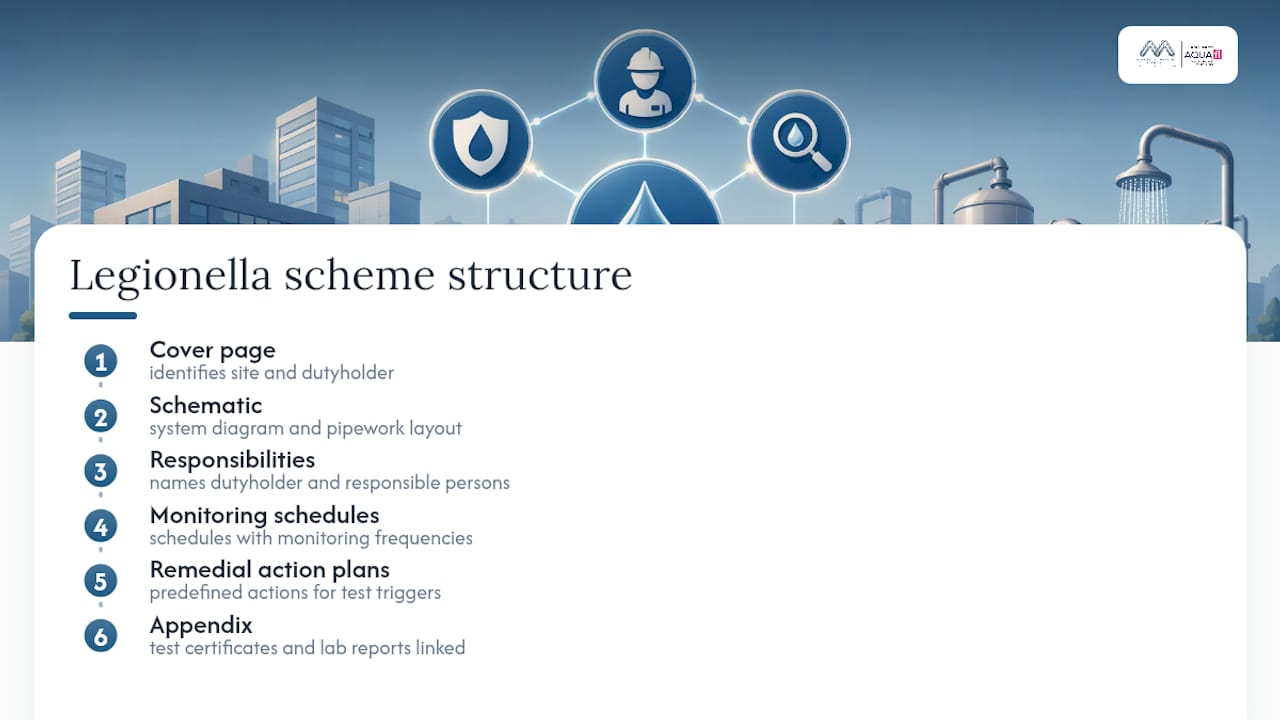
A workable scheme document generally follows a consistent shape: a cover page identifying the site and dutyholder, the schematic, a responsibilities section naming the dutyholder and responsible persons, monitoring schedules with frequencies, predefined remedial action plans, and an appendix for test certificates and lab reports. Building your own from scratch, or adapting a method of works framework, gives you a structure to slot site-specific detail into rather than starting with a blank page.
Digital logbooks and automated temperature monitoring make audits considerably faster. Everything’s timestamped and searchable, and you’re not hunting through a lever-arch file when an inspector asks for six months of records. Paper still works for smaller sites, but retrieval gets harder as records accumulate, and a missing page is far easier to lose than a corrupted digital entry is to recover.
Pro Tip: Link every lab certificate directly to the remedial action it triggered. An inspector who sees a positive sample result with no corresponding action logged will assume, reasonably, that nothing was done about it.
What does a professional written scheme engagement look like?
Commissioning a specialist rather than building everything in-house typically follows a predictable sequence. A provider such as Bespoke Compliance Solutions generally delivers:
A completed legionella risk assessment report
The written scheme document itself
A current schematic diagram
A monitoring schedule tailored to the site’s systems
A bespoke logbook system for ongoing records
An awareness training session for on-site staff
Ongoing consultancy support as systems or occupancy change
A typical engagement runs in this order:
Site visit and system survey
Draft written scheme prepared for review
Client review and sign-off
Handover and staff training
Monitoring and record-keeping begins
Cost varies by site complexity and how many systems fall in scope, which is why a site-specific quote, rather than a flat headline price, is the norm across the sector.
Publisher perspective on what actually makes a scheme work
Too many written schemes read like they were written to satisfy an inspector rather than to guide the person doing the Tuesday morning temperature round. The best ones read as operational manuals: plain steps, current schematics, named people, no ambiguity about what “remedial action” actually means in practice. The most common pitfalls I see are outdated diagrams, vague instructions that don’t specify a threshold or a contact, and nobody named with clear competence to act. Refresh operational training every 12 months, sooner if staff turnover is high, so the people executing the scheme aren’t relying on memory from an induction two years ago.
Get a written scheme drafted and implemented properly
If you’ve read this far and you’re still not confident your site’s scheme would survive an inspection, that’s usually a sign it needs a proper review rather than another internal patch-up. Bespoke Compliance Solutions handles the whole process for commercial, healthcare and education sites: risk assessments, written scheme drafting, water sampling and testing, staff training, and remedial works when a check flags a problem.
[
Every engagement starts with a site survey, followed by a clear quote and a defined deliverable list before any work begins, so you know exactly what you’re getting and when. If your business operates from offices or commercial premises, the legionella compliance service for offices and commercial premises page sets out how a site visit and quote works. Get in touch to arrange a survey and find out what a properly documented scheme would look like for your building.
Sources
For exact legal wording, consult ACOP L8, HSG274 for technical detail, and INDG458 for a concise summary aimed at landlords and building managers.
This article is general information, not a substitute for advice from a qualified doctor. Consult a qualified healthcare professional about your own circumstances before acting on anything here.
Legionnaires’ disease: The control of legionella bacteria in water systems. Approved Code of Practice and guidance on regulations L8
FAQ
What is a written scheme of control for legionella?
It’s the operational document that sets out how a site’s water systems are monitored and controlled for legionella risk, including schematics, monitoring frequencies, remedial actions and named responsible persons, as required by ACOP L8.
What is the UK legislation on legionella?
There’s no single “legionella law.” Duties flow from the Health and Safety at Work etc. Act and the Control of Substances Hazardous to Health (COSHH) Regulations, with ACOP L8 setting the benchmark standard HSE expects dutyholders to follow.
Who is responsible for managing the legionella written scheme?
The dutyholder, usually the employer or person in control of the premises, holds overall legal responsibility and appoints a competent responsible person to manage and implement the scheme day to day.
How much does a legionella risk assessment cost in the UK?
Costs vary by site size, system complexity and number of water outlets, so most providers, including Bespoke Compliance Solutions, quote per site after a survey rather than publishing a flat price.
Recommended
Comments