
Stop Audit Failures: Sampling Plan Design for UK Dutyholders
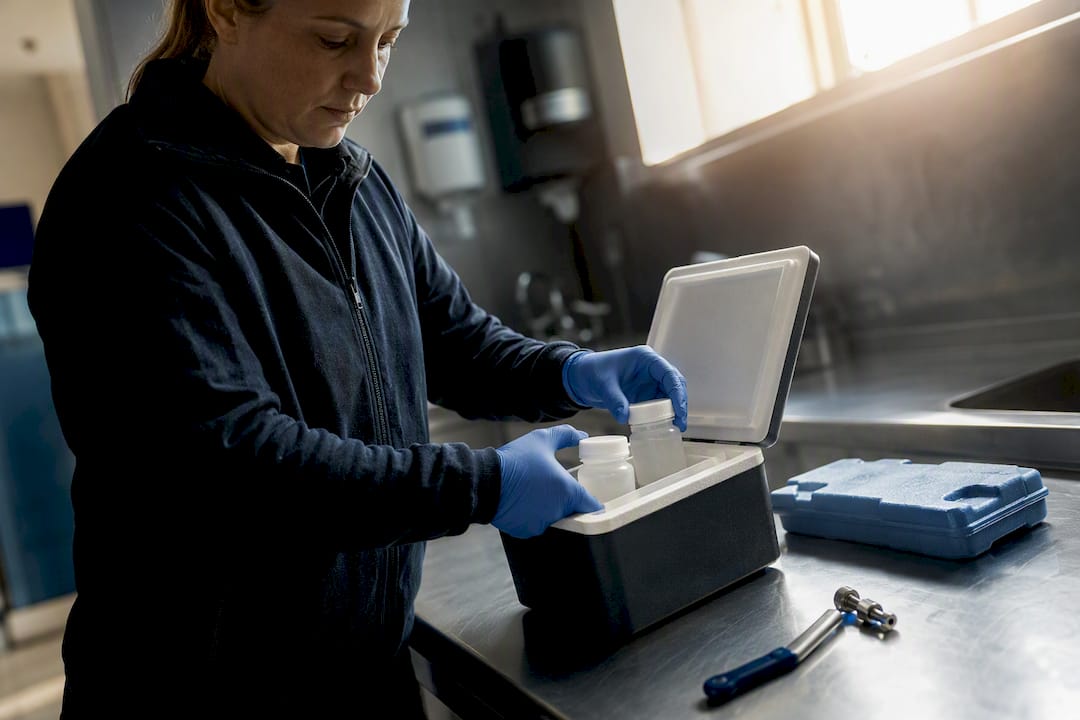
A sampling plan is a site-specific, documented schedule of sample locations, types, methods and records used to verify that a written scheme of control is working. It sits alongside temperature monitoring, not instead of it. The main reference points are HSE’s HSG274 and ACOP L8, with laboratory work carried out to UKAS accreditation using ISO 11731 or BS 7592 culture methods.
TL;DR:
Quarterly Legionella sampling is recommended for cooling towers, supported by weekly water treatment checks, to ensure early detection of contamination.
Routine sampling for hot and cold water systems depends on temperature control and flushing practices, not on fixed schedules; additional tests are triggered by specific events.
Samples must arrive at the laboratory within 24 to 48 hours and be collected with the correct preservative to avoid result distortion or inaccuracies.
A competent person must interpret results in context, considering detection limits, sample history, and system conditions before deciding on remedial actions.
Proper sample points include system sentinels, dead legs, and high-exposure fittings, with sampling locations chosen based on risk rather than convenience.
Table of Contents
Where should sample points sit? Sentinels, dead legs and coverage
How often should you sample, and what triggers extra testing?
Getting samples from outlet to lab without ruining the result
What do the results actually mean, and what should you do next?
What are the core UK regulatory requirements for Legionella control?
Author perspective: common pitfalls and what adds value in practice
How specialist compliance providers support sampling plan design
What must a compliant, site-specific sampling plan contain?
A sampling plan that would survive scrutiny from an environmental health officer or a client’s compliance audit needs more than a list of taps. It has to trace, in writing, exactly how each sample connects back to the system and the decisions that follow from it.
A schematic diagram of the water system with every sample point labelled against a fixed outlet ID, not a vague description like “third floor kitchen”.
A written rationale for each point: why that location was chosen, what sample type is taken there, and how often.
Trigger events that force sampling outside the routine schedule, such as a control failure or unexplained positive result.
Chain of custody fields on every sample: sampler identity, exact date and time, precise location text, and notes on recent flushing or disinfection.
Named laboratory methods and accreditation status, specifying UKAS accreditation and testing to ISO 11731 or BS 7592.
A plan missing any of these becomes hard to defend after the fact, because nobody can prove the sample taken in March came from the same outlet as the one taken in June.
Where should sample points sit? Sentinels, dead legs and coverage
Picking outlets because they’re easy to reach is the single most common design fault we see. A defensible plan works the other way round: it starts with the system’s layout and picks points that expose weaknesses, not convenience.
Map near and far sentinels first. These are the outlets closest to and furthest from each calorifier or hot water storage vessel, plus the extremities of risers and spurs, because temperature and stagnation problems show up at the edges of a system before anywhere else.
Flag dead legs and little-used outlets separately. Disused pipework, rarely-flushed cupboards and infrequently occupied rooms hold water longer than anywhere else, and that’s exactly where biofilm and stagnation risk concentrates.
Prioritise high-exposure fittings. Showers, TMVs and spa pool jets aerosolise water, so they carry a higher exposure risk even when the water chemistry looks unremarkable.
Scale sample count to system complexity. A single-riser office block might need only a handful of sentinel points; a multi-riser hospital or hotel estate needs enough points to represent every loop, not a fixed number picked in advance.
Never composite samples. Mixing water from several outlets into one bottle destroys the ability to trace a positive result back to its source, and it makes repeat sampling meaningless.
Sentinel sampling done properly should be repeatable: the same technician, or a different one entirely, should be able to return in six months and sample precisely the same point.
How often should you sample, and what triggers extra testing?
Sampling frequency isn’t fixed by law. HSE frames it as risk-based, meaning the schedule follows what the risk assessment and system design actually demand, not a blanket annual habit.
Spa pools: monthly Legionella sampling alongside daily operational checks on disinfectant residual and pH.
Healthcare and other high-risk premises: stricter, risk-assessment-driven schedules, often quarterly, and shaped by sector-specific infection control guidance where it applies.
Standard hot and cold water systems: routine sampling isn’t required at all where temperature monitoring and flushing demonstrate control is holding.
Extra sampling gets triggered by events, not the calendar: a control failure, remedial works or disinfection, a refurbishment that’s altered pipework, an outbreak investigation, or a positive result nobody can explain. Any one of those should push you into diagnostic sampling immediately, regardless of where you are in the routine cycle.
Getting samples from outlet to lab without ruining the result
Good sampling technique is wasted if the bottle sits in a van boot for four days. The mechanics of collection and transport matter as much as choosing the right outlet.
Use the correct bottle and preservative. Chlorinated systems need sodium thiosulphate to neutralise residual disinfectant, otherwise the sample keeps “disinfecting” itself after collection.
Take the volume the laboratory specifies, and label every bottle with outlet ID, date, time and sampler name before it leaves the site.
Get samples to the lab fast. HSE guidance points to receipt within 24 to 48 hours for culture-based testing, because delays let bacteria die off or multiply unpredictably in transit.
Insist on UKAS accreditation and testing to ISO 11731 or BS 7592 culture methods.
Pro Tip: Ask your laboratory what their standard detection limit is before you sign a contract. Culture methods should reliably detect down to around 100 legionella bacteria per litre; anything coarser and a genuinely contaminated outlet could return a clean-looking negative.
Send documentation with every batch: site name, outlet ID, sampler identity, exact date and time, and a note on any flushing or disinfection carried out in the days before sampling. Without that context, a lab result is just a number with nothing to anchor it to.
What do the results actually mean, and what should you do next?
A number on a lab report doesn’t tell you anything on its own. It has to be read against detection limits, sample history and what’s physically happening in that part of the system.
Treat a negative as reassurance, not proof. Detection limits mean low-level contamination can sit below what culture methods pick up, and biofilm reservoirs can harbour bacteria that a single sample misses entirely.
Match the response to the result. A clean result within expected range means continue routine surveillance; a borderline or unexpected result means re-sample promptly before deciding anything; a genuinely high count means remedial cleaning or disinfection, followed by confirmatory re-testing.
Look at the trend, not the single data point. One result read against six months of history tells you whether you’re looking at a one-off anomaly or the early sign of a system drifting out of control.
Put a competent person in charge of the call. Someone with the training to weigh detection limits, sample location and history against each other should make the decision, and that decision needs writing down.
Pro Tip: Keep a simple trend chart for every sentinel point rather than a stack of individual PDF reports. A single unexpected reading is far easier to judge in context when you can see the last four or five results sitting next to it.
Where does the sampling plan sit in the written scheme?
The sampling plan isn’t a standalone document. It’s referenced directly from the written scheme of control and the risk assessment that informed it, and it should be easy for an inspector to trace from one to the other.
Store the plan alongside the risk assessment and reference it explicitly within the written scheme, not as a loose attachment nobody can find.
Keep sample results, chain of custody paperwork, corrective actions and review dates in one place for the retention period your organisation applies.
Assign clear roles: who’s the competent person, who’s the contractor doing remedial works, and who signs off that the action was completed.
Review the plan whenever the system changes, when usage patterns shift, or when results start trending the wrong way, not just on a fixed annual date.
A logbook system that ties sampling records directly to the written scheme makes this far easier to audit than scattered spreadsheets and email trails.
Who is qualified to take and interpret samples?
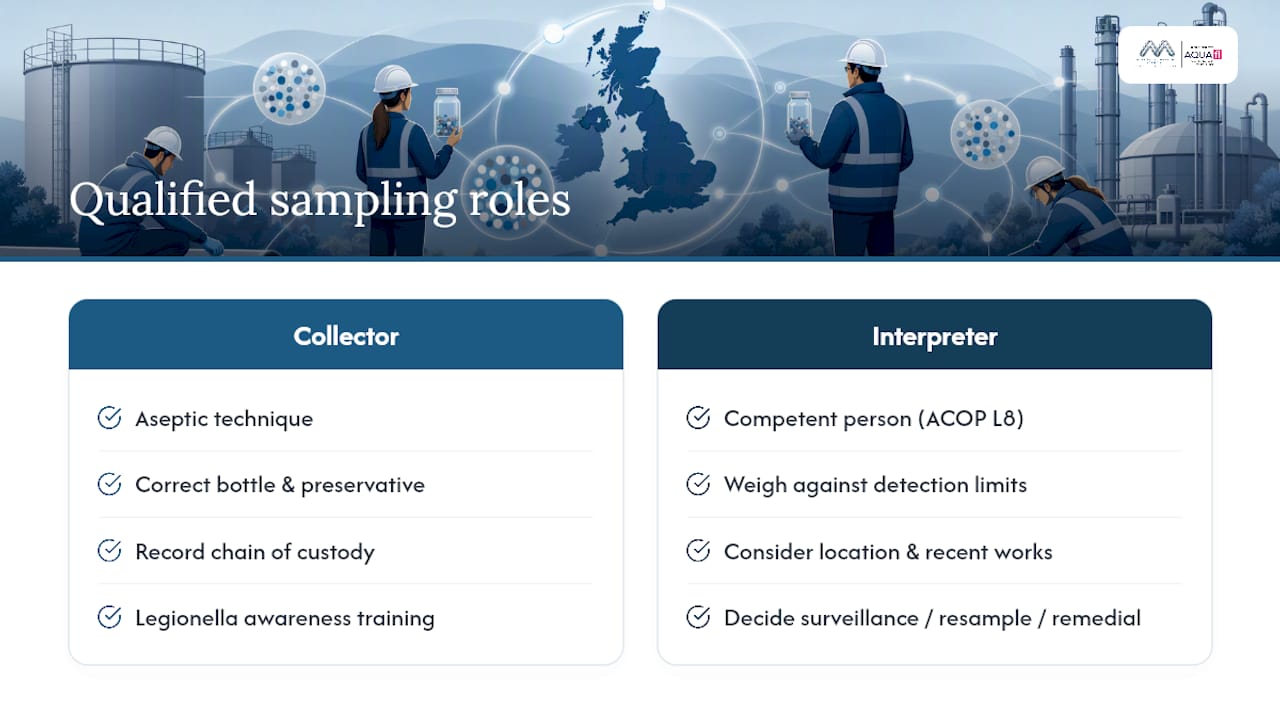
Sample collection isn’t a job to hand to whoever’s free that afternoon. Poor technique, wrong preservative, or a bottle left in a warm van all undermine a result before it even reaches the laboratory.
Anyone collecting samples should understand basic aseptic technique: how to avoid contaminating the sample from their own hands or the outlet fitting, how to select and use the correct bottle and preservative, and how to record chain of custody details accurately. This is typically covered within Legionella awareness training alongside temperature monitoring and visual inspection skills, rather than as a separate qualification.
Interpretation is a different skill entirely, and it sits with the competent person named under ACOP L8. That person needs enough technical grounding to weigh a result against detection limits, sample location, recent works and historical trends, then decide whether the response is surveillance, re-sampling or remedial action. Many dutyholders don’t have this expertise in-house, which is exactly why ACOP L8 allows for external competent persons to be appointed.
Training records themselves become part of your audit trail. If an inspector asks who took a sample and what qualified them to do so, you need a paper answer ready, not a verbal assurance. Refresher training matters too, particularly where staff turnover means the person who took last year’s samples has moved on and someone new has taken over without a handover.
What happens if you get an unexpected positive result?
An unexplained positive result, particularly a high count, needs a response plan drafted before it happens, not improvised on the day.
The immediate step is isolating the affected outlet or system section if there’s any ongoing exposure risk, particularly for aerosol-generating fittings like showers or spa pool jets. Re-sampling follows quickly to confirm whether the result is genuine or an anomaly tied to sampling technique, transit delay, or a temporary event like recent works nearby.
If the result is confirmed, remedial action typically means disinfection of the affected section, sometimes escalating to wider system disinfection depending on how the contamination has spread. Confirmatory re-testing after remedial work verifies the intervention worked, and that verification sample follows the exact same rigour as the original: same outlet, same documentation, same lab standards.
For genuine outbreak scenarios, where illness has been linked to a site, the response moves beyond routine remedial action into formal investigation, usually involving your local authority environmental health team and, in some cases, UKHSA. Every step, from the first unexpected result through to final clearance, needs contemporaneous written records: what was found, what was done, when, and by whom.
Building this contingency pathway into the written scheme before you need it saves valuable time when a result does come back wrong, and it demonstrates to any inspector that your organisation had a plan rather than a scramble.
How does the risk assessment shape sampling plan design?
The risk assessment comes first, always. Sampling plan design without a current risk assessment behind it is just guesswork dressed up as method.
A proper risk assessment identifies every water system on site, maps out storage, distribution and outlets, and flags the specific features that raise risk: dead legs, infrequently used rooms, calorifiers operating below temperature, or aerosol-generating fittings. That map is what tells you where sentinel points actually need to go, rather than which taps happen to be nearest the plant room door.
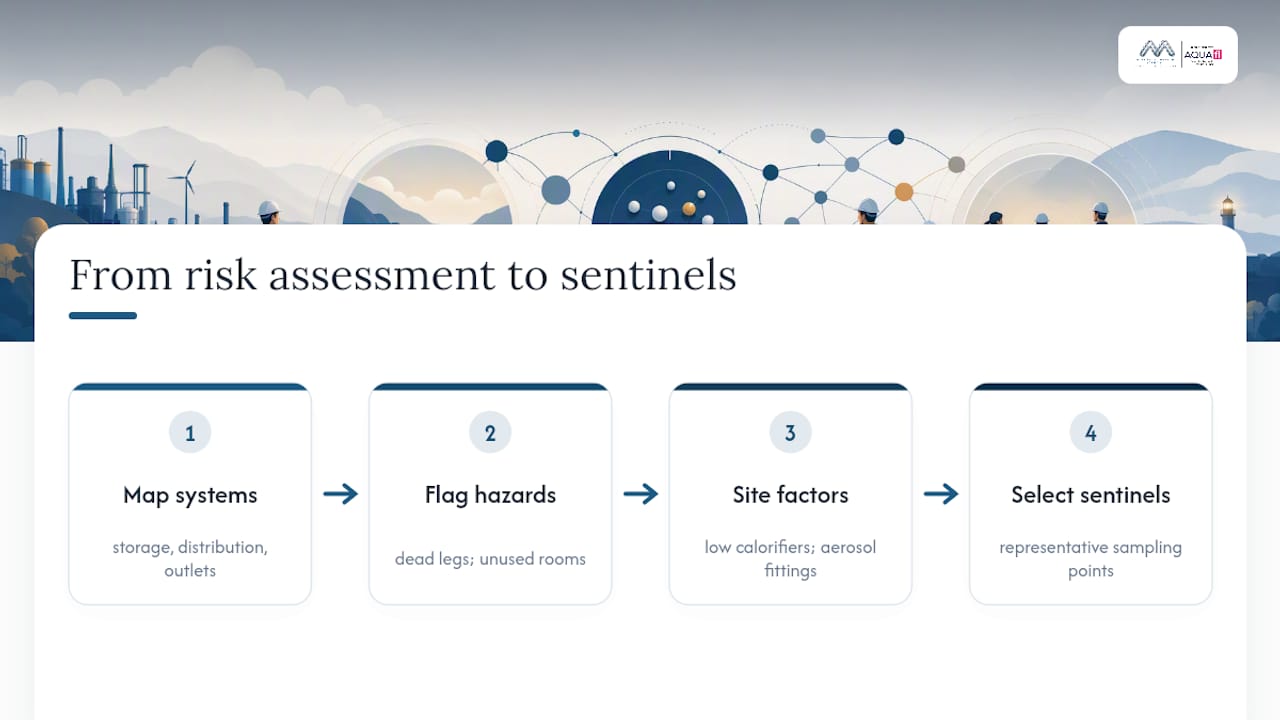
Risk assessments also flag site-specific factors that generic sampling schedules miss entirely: a wing of a building mothballed for refurbishment, a recently installed TMV that hasn’t been commissioned properly, or a cooling tower operating outside its normal season. Each of these changes where and how often sampling should happen, and none of them show up if the sampling plan is copied from a template rather than built from the current assessment.
Reviewing the risk assessment regularly, and updating the sampling plan whenever it changes, keeps the two documents aligned. A sampling plan built against a three-year-old risk assessment on a building that’s since had rooms remodelled or systems altered isn’t verifying anything meaningful anymore, it’s just testing outlets that may no longer represent where the actual risk sits.
What are the core UK regulatory requirements for Legionella control?
UK Legionella compliance sits under health and safety law, not a bolt-on environmental regulation. The Health and Safety at Work Act 1974 and the Control of Substances Hazardous to Health Regulations (COSHH) both apply, with ACOP L8 setting out how dutyholders are expected to meet those duties in practice.
ACOP L8 requires every relevant premises to identify and assess the risk, appoint a competent person, and prepare a written scheme of control where the risk assessment shows one is needed. That scheme has to describe the system, set out control measures, and define monitoring and record-keeping practices that demonstrate control is being maintained over time.
HSG274 supplements ACOP L8 with detailed technical guidance across three parts, covering evaporative cooling systems, hot and cold water systems, and other risk systems like spa pools and misting equipment. It’s the document that translates the legal duty into practical detail: what temperatures to maintain, how often to flush little-used outlets, and when operational monitoring needs to escalate into laboratory sampling.
Dutyholders are legally responsible for demonstrating compliance, not just achieving it. Records, sampling plans, remedial actions and competent person appointments all need to be available for inspection, and enforcement action follows from gaps in the paper trail as often as it does from an actual outbreak.
Author perspective: common pitfalls and what adds value in practice
The plans that fail on inspection almost always share the same faults: blanket annual testing with no rationale, outlets picked for ease of access rather than risk, and chain of custody paperwork that’s missing half its fields. None of that is expensive to fix.
What actually moves the needle is unglamorous: an accurate schematic, sentinel points chosen against the system rather than convenience, samples reaching a UKAS lab within that 24 to 48 hour window, and a competent person who reads results in context rather than in isolation. Get those right and the rest of the compliance picture tends to follow.
— Sammi
How specialist compliance providers support sampling plan design
Specialist compliance providers can assist with site-specific sampling plans built from current risk assessments, liaise directly with UKAS-accredited laboratories, and integrate the process into written schemes and logbook systems that stand up to inspection.
[
This is the right route when in-house competence is limited, when a system is complex enough that generic sentinel guidance doesn’t quite fit, or when a healthcare or high-risk site needs a stricter cadence than a standard commercial building. We also handle the remedial side, from tank cleaning and disinfection through to logbook implementation, so a positive result doesn’t leave you searching for a contractor mid-crisis.
If you need a sampling plan built around your actual system rather than a template, start with our water testing and Legionella analysis service, or book a site-specific Legionella risk assessment to establish the groundwork first.
Authoritative guidance and standards to keep to hand
ACOP L8 and HSG274 Part 1 for dutyholder duties, written scheme and monitoring expectations.
UKAS accreditation and ISO 11731 / BS 7592 for laboratory culture testing standards.
HTM 04-01 for healthcare-specific water safety guidance where it applies to your premises.
FAQ
What is a Legionella sampling plan?
It’s a site-specific, documented schedule of sample locations, sample types, collection methods and records used to verify that a written scheme of control is actually working, rather than a replacement for temperature monitoring.
How often should cooling towers be sampled for Legionella?
HSE guidance points to a quarterly baseline for cooling tower Legionella sampling, supported by weekly water treatment checks in between.
Do all hot and cold water systems need routine Legionella sampling?
No. Routine sampling isn’t required where temperature monitoring and flushing show the system is under control; sampling is used for verification or diagnosis, not as a blanket requirement.
How quickly should samples reach the laboratory?
Aim for laboratory receipt within 24 to 48 hours for culture-based testing, since delays can distort results either way.
Who should interpret Legionella sampling results?
A competent person, as defined under ACOP L8, should interpret results against detection limits, sample history and system context, then decide on any remedial action.
Can Bespoke Compliance Solutions design our sampling plan?
Yes. Bespoke Compliance Solutions drafts site-specific sampling plans, coordinates with UKAS-accredited laboratories, and integrates the plan into your written scheme and logbook records.
Recommended
Comments