
Legionella prevention in commercial HVAC: A practical guide
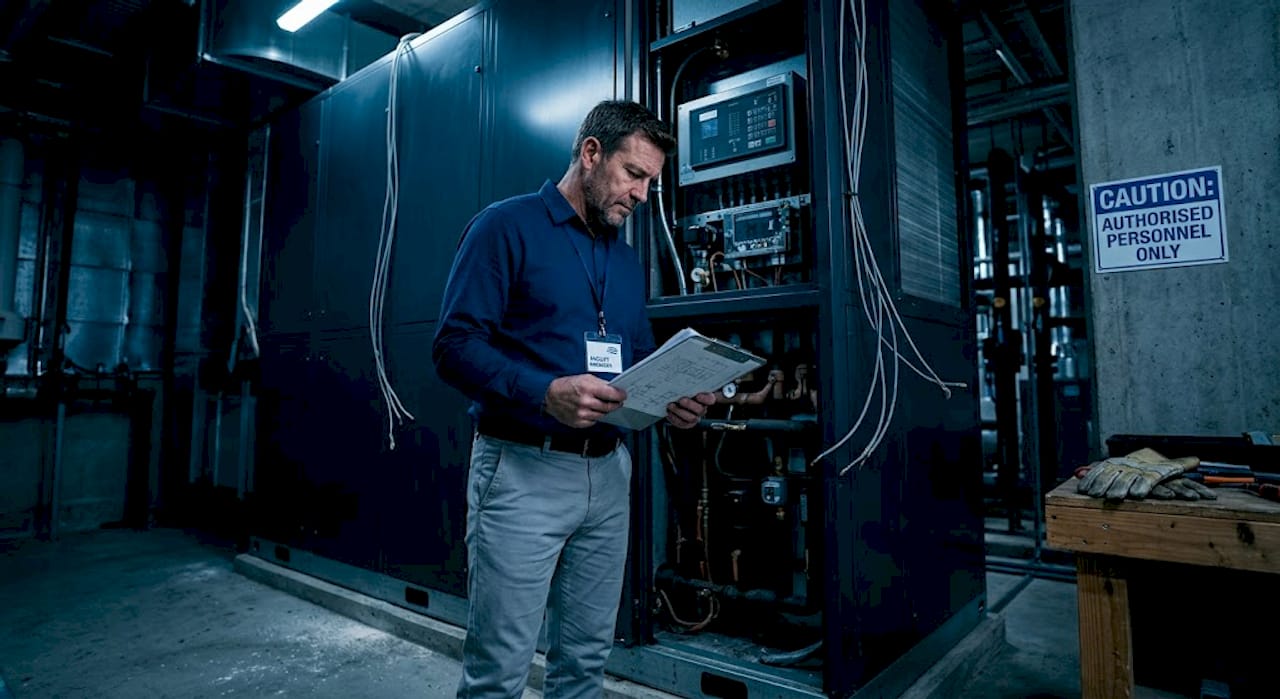
One missed step in your Legionella control programme can trigger an outbreak, a Health and Safety Executive investigation, and potential closure of your building. For facility managers and compliance officers in commercial properties and healthcare settings, Legionella outbreaks in HVAC carry consequences that go far beyond a failed audit. This guide walks you through every practical layer of prevention, from understanding where the bacteria thrives in your systems, to executing controls, verifying their effectiveness, and keeping the records that protect your organisation.
Table of Contents
Key Takeaways
Point | Details |
Temperature control is critical | Keeping hot and cold water in the right temperature range makes Legionella growth far less likely. |
Regular maintenance prevents outbreaks | Monthly monitoring, periodic cleaning, and flushing of dead legs control widespread risks in HVAC systems. |
Combine testing with physical controls | Testing identifies issues but should always be supported by cleaning, chemical treatment, and system checks. |
Smart design lowers long-term risk | Eliminating dead legs and keeping condensate pans clean reduce the chance of future contamination. |
Thorough records ensure compliance | Documentation and audits are vital to satisfy HSE inspectors and defend your duty of care. |
Understanding Legionella risk in HVAC systems
To understand how to prevent Legionella, you first need to recognise where it thrives and which laws govern your responsibilities.
Legionella pneumophila is a waterborne bacterium that causes Legionnaires’ disease, a severe form of pneumonia, when contaminated water droplets are inhaled. It does not spread person to person. Instead, it colonises water systems where conditions are favourable: temperatures between 20°C and 45°C, stagnation, scale, sediment, and biofilm. HVAC systems create exactly these conditions across multiple components.
The highest-risk components in commercial HVAC include:
Cooling towers and evaporative condensers: These generate aerosols and operate at temperatures ideal for bacterial growth
Hot and cold water storage tanks: Particularly at risk when water sits at intermediate temperatures
Condensate drip pans and drain lines: Often overlooked, these collect standing water and organic matter
Dead legs and infrequently used outlets: Stagnant water in pipework is a primary breeding ground
Showers, spray taps, and humidifiers: Any outlet that creates a fine mist or aerosol is a transmission risk
The legal framework is clear. HSG274 Part 1 provides technical guidance specifically for evaporative cooling systems, and it is the benchmark the HSE uses during investigations. ACOP L8 sets the overarching duty of care for all water systems under the Health and Safety at Work Act 1974. Together, these documents define what competent management looks like. In healthcare settings, the stakes are even higher because patients are immunocompromised. Understanding Legionella compliance in healthcare requires an additional layer of vigilance beyond standard commercial requirements.
An outbreak does not just harm people. It triggers regulatory investigation, potential prosecution, reputational damage, and in severe cases, temporary closure. The legal and human cost of inaction is simply too high.
Pro Tip: Do not wait for a risk assessment to flag a problem. Walk your plant room and look for any pipework that terminates without regular use. These dead legs are among the most common sources of Legionella colonisation found during investigations.
Essential requirements and preparation checklist
Armed with the fundamentals, it is critical to make sure you are compliant and ready before any practical steps are taken.
Before you implement any control measures, you need the correct foundations in place. ACOP L8 requirements mandate a written risk assessment, an ongoing written control scheme, a competent responsible person, and records kept for a minimum of five years. These are not optional best practices. They are legal obligations.
The table below summarises what you need before implementing controls:
Requirement | Detail | Who is responsible |
Legionella risk assessment | Written, site-specific, reviewed regularly | Duty holder or competent contractor |
Written control scheme | Documents all control measures and frequencies | Responsible person |
Responsible person | Named, trained, and competent | Duty holder appoints |
Asset inventory | All HVAC water systems listed and risk-rated | Responsible person |
Records and logbooks | Minimum 5 years retention | Responsible person |
PPE and equipment | Thermometers, PPE, sampling kits | Facilities team |
Beyond the legal paperwork, your preparation checklist should include:
Asset inventory: Every water system, tank, cooling tower, and outlet must be identified and risk-rated
Schematic drawings: Up-to-date pipework diagrams help identify dead legs and low-use areas
Assigned roles: Who carries out weekly checks, who reviews monthly data, and who escalates issues?
Calibrated equipment: Thermometers used for compliance monitoring must be calibrated and logged
Contractor competence: Any third party carrying out work on your water systems must demonstrate competence
Your method of works for compliance should be documented before a single temperature check is carried out. Improvised compliance is not compliance.
Pro Tip: Review your asset register every time there is a refurbishment or change of use in your building. New pipework runs, added floors, or repurposed rooms all change your risk profile and must be reflected in your risk assessment.
Step-by-step Legionella prevention actions for commercial HVAC
Now you have the requirements in place, here is how to execute each key control step and avoid common mistakes.
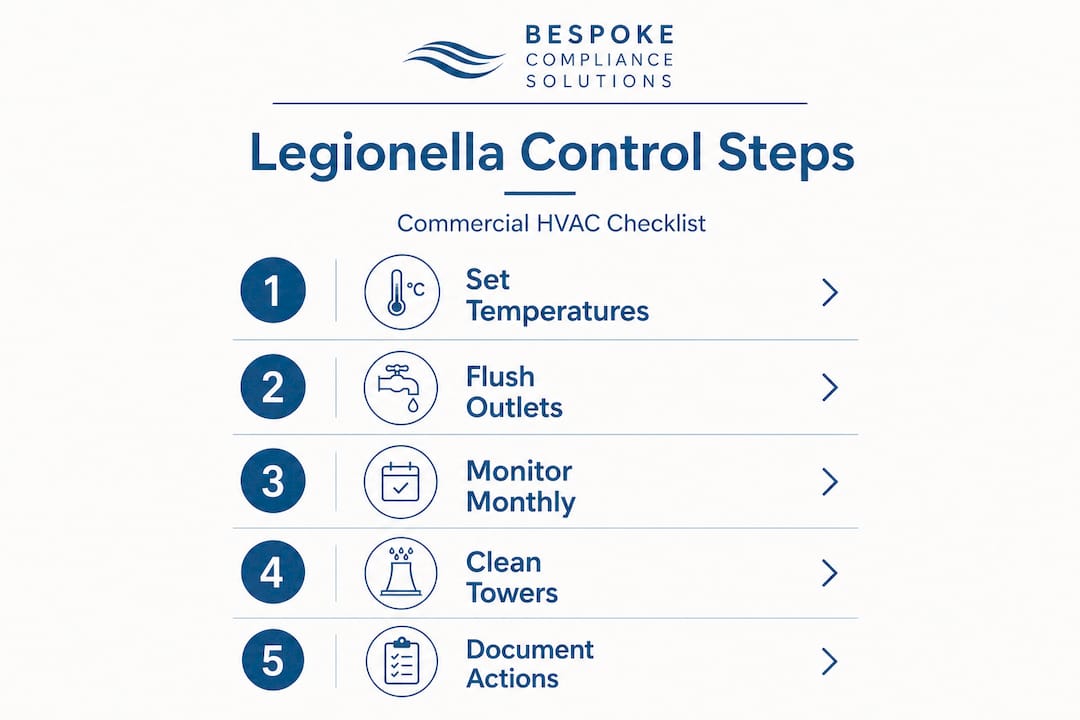
1. Set and verify correct water temperatures
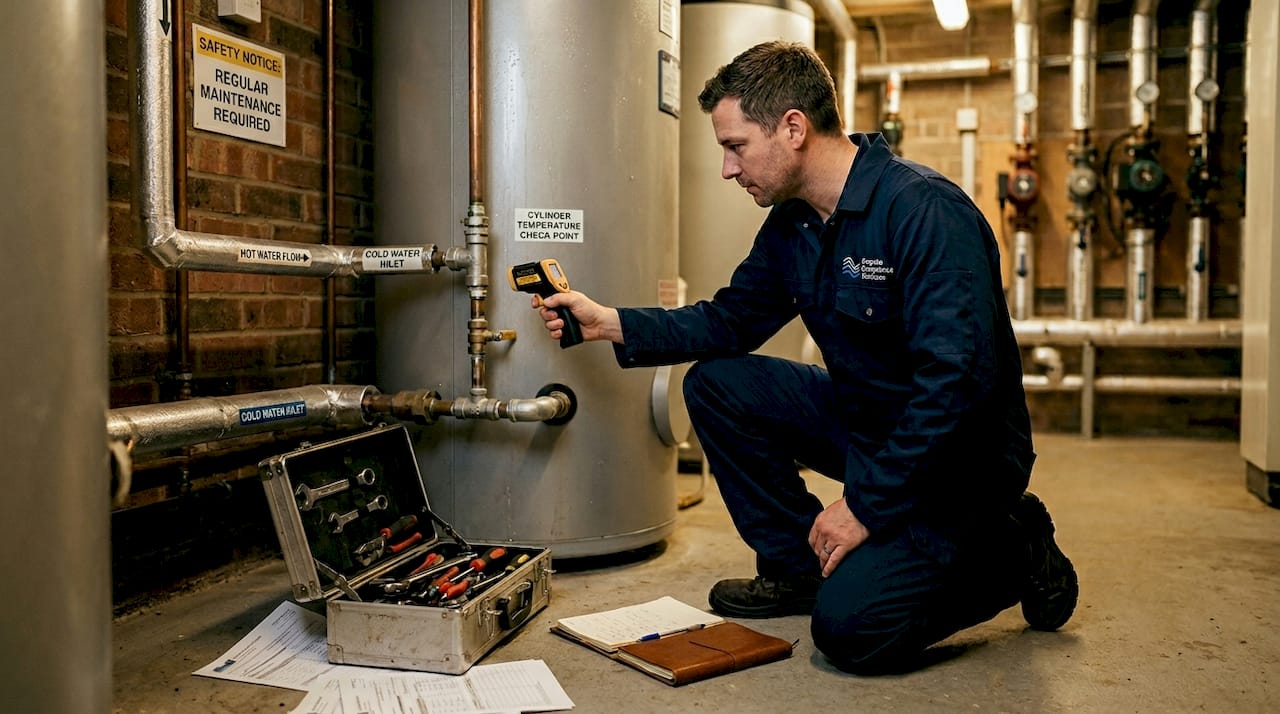
Temperature controls are your primary line of defence. Hot water must be stored at above 60°C and distributed at above 50°C at all outlets. Cold water should be stored and distributed below 20°C. These thresholds inhibit Legionella growth. Any system operating outside these parameters is a risk. Check your calorifier thermostat settings and confirm that sentinel outlets (the first and last on each circuit) reach target temperatures. Use temperature monitoring for compliance as a structured, logged activity rather than an informal walk-round.
2. Carry out weekly flushing of low-use outlets
Any outlet that is not used at least once a week must be flushed. This includes toilets in meeting rooms, showers in changing facilities used only occasionally, and taps in infrequently visited areas. Routine maintenance and flushing should include weekly flushing of stagnant outlets and dead legs, monthly temperature monitoring at sentinel outlets, and quarterly cleaning of showers including showerheads and hoses.
3. Perform monthly sentinel outlet temperature checks
Monthly temperature monitoring at sentinel outlets gives you trend data. A single reading tells you the temperature on one day. A trend tells you whether your system is drifting. Log every reading with the date, time, outlet location, and the name of the person carrying out the check. Review the data monthly and act immediately if any reading falls outside the acceptable range. Learn how to carry out performing temperature checks correctly to ensure your data is reliable.
4. Clean and disinfect cooling towers
Cooling towers must be notified to your local authority. This is a legal requirement under the Notification of Cooling Towers and Evaporative Condensers Regulations 1992. Beyond notification, cooling towers require a chemical treatment programme including biocides, corrosion inhibitors, and scale control. They also require physical cleaning at least twice a year, and Legionella sampling to verify control. Any tower that is taken out of service must be cleaned and disinfected before recommissioning.
5. Address low-occupancy and seasonal risks
Buildings with variable occupancy, such as offices with hybrid working patterns or seasonal facilities, face a specific risk. Water sits in pipework for days or weeks without movement. Implement a targeted flushing regime for all areas with reduced use. When a building reopens after a period of closure, carry out a full system flush and temperature check before occupants return.
Safety warning: Chemical biocides used in cooling tower treatment are hazardous substances. Always follow COSHH (Control of Substances Hazardous to Health) regulations. Wear appropriate PPE including gloves, eye protection, and respiratory protection where required. Never mix chemicals without specific guidance from your supplier.
The comparison below summarises key maintenance frequencies:
Control measure | Frequency | Risk if missed |
Flushing of low-use outlets | Weekly | Stagnation and bacterial growth |
Sentinel outlet temperature checks | Monthly | Undetected temperature drift |
Showerhead descaling and cleaning | Quarterly | Biofilm and scale accumulation |
Cooling tower clean and disinfection | Twice yearly minimum | Aerosol-borne Legionella risk |
Full system risk assessment review | Annually or after changes | Outdated controls and blind spots |
Verification, monitoring, and documentation
With practical steps complete, validation and record-keeping are essential to close the compliance loop and protect your site.
Carrying out control measures is only half the job. You must also verify that they are working. Temperature monitoring is the primary verification tool, but it has limits. A reading at a sentinel outlet tells you about that outlet on that day. It does not tell you what is happening in the middle of a long pipework run or inside a cooling tower basin.
Legionella testing methods fall into two main categories. Culture testing is the traditional method. Water samples are sent to an accredited laboratory, and results are returned in 10 to 14 days. It detects viable, culturable Legionella and is the standard for regulatory action thresholds. PCR (polymerase chain reaction) testing is faster, often returning results within 24 to 48 hours, and PCR vs culture testing shows that PCR detects a broader range of organisms but cannot distinguish between viable and non-viable cells. The practical implication: use PCR for rapid screening and culture testing for regulatory compliance and action decisions. Combining both gives you the most complete picture.
Your documentation should include:
Temperature monitoring logs: Date, time, location, reading, and operative name
Water sample certificates: Laboratory results with date, location, and method
Cleaning and disinfection records: What was done, when, by whom, and with which products
Incident records: Any exceedance, corrective action taken, and outcome
Risk assessment and control scheme: Current versions with review dates
Contractor visit records: Competence evidence, method statements, and reports
Interpreting Legionella samples correctly is a skill in itself. A positive result does not always mean immediate closure. It means immediate investigation, review of controls, and likely disinfection. Knowing how to respond proportionately is part of competent management.
Automated temperature monitoring is increasingly used in larger commercial and healthcare buildings. Sensors log temperatures continuously and flag exceedances in real time. This removes the risk of a monthly check missing a week-long temperature drift and significantly reduces the administrative burden on your team.
The primary methodology remains temperature control as the first line of defence, supplemented by cleaning and disinfection. Monitoring alone is not enough. A building that tests regularly but neglects physical cleaning and temperature management is not compliant. It is simply generating paperwork.
Low office occupancy trends have made stagnation in unused outlets a growing and frequently overlooked risk. Hybrid working has changed the occupancy profile of millions of commercial buildings across the UK. If your flushing regime was designed for full occupancy, it needs to be reviewed.
Pro Tip: Schedule an independent audit of your Legionella control scheme at least once a year. An internal review can miss what familiarity hides. A fresh set of eyes, particularly from a specialist, will identify gaps that your team has stopped noticing.
A fresh perspective: What most Legionella guides miss in commercial HVAC
Even a thorough control programme can fall short. Here is where experienced practitioners see most sites go wrong.
Most guides cover temperature targets and flushing frequencies. What they rarely address is the false sense of security that comes from a well-maintained logbook. We have seen sites with immaculate records and active Legionella colonisation. The two are not mutually exclusive.
The first blind spot is system design. HVAC systems must be designed to minimise dead legs and short pipework, and condensate pans must drain freely and be cleaned regularly to prevent bacterial and mould growth. When a building is refurbished or extended, new pipework is often added without removing or capping old runs. Dead legs accumulate over years of incremental change. No amount of flushing compensates for pipework that was never designed to be flushed.
The second blind spot is condensate management. Condensate drip pans in air handling units collect moisture continuously. If the drain is even partially blocked, you have standing water at ambient temperature in a dark, warm environment. This is not a theoretical risk. It is a common finding during specialist inspections, and it is almost never picked up by a standard temperature monitoring regime.
The third blind spot is over-reliance on sensors. Automated monitoring is genuinely valuable, but sensors measure what they are positioned to measure. They do not detect biofilm forming on the interior of a tank. They do not alert you when a showerhead is clogged with scale. Physical inspection and cleaning remain irreplaceable.
Responsible persons and facility managers should be aware that the HSE uses HSG274 as its benchmark during investigations. If your control scheme does not reference HSG274 and demonstrate compliance with its technical guidance, you are exposed. Audit your scheme against it annually, not just when a risk assessment is due.
The most resilient Legionella programmes we work with share one characteristic: they treat compliance as an operational discipline, not a paperwork exercise. The logbook is evidence of what happened, not a substitute for it happening.
Expert support for Legionella compliance
Managing Legionella risk across commercial or healthcare premises is demanding, and the consequences of getting it wrong are serious. That is where specialist support makes a real difference.

At Bespoke Compliance Solutions, we work directly with facility managers and compliance officers to design and implement control programmes that are genuinely bespoke to your sites. From Legionella solutions for offices and commercial premises through to complex healthcare environments, we provide risk assessments, water sampling and analysis, training, logbook systems, and ongoing consultancy. You can review our compliance method to understand how we approach each site systematically. For larger sites, our automated temperature checks service removes the manual burden from your team while providing continuous, auditable data. Our goal is straightforward: make compliance simple, effective, and sustainable for your organisation.
Frequently asked questions
What is the legal requirement for Legionella risk assessments in commercial HVAC systems?
ACOP L8 requires a written risk assessment, an ongoing written control scheme, appointment of a competent responsible person, and retention of all records for a minimum of five years.
How often should water temperatures be checked in commercial HVAC Legionella schemes?
Routine maintenance requires monthly temperature monitoring at sentinel outlets, with weekly flushing carried out on any stagnant outlets or dead legs to prevent bacterial colonisation.
What temperature should hot and cold water be to control Legionella?
Hot water storage must be above 60°C, distributed above 50°C at outlets, and cold water must be stored and distributed below 20°C to inhibit Legionella growth effectively.
What is an overlooked risk for Legionella in commercial office buildings?
Low occupancy leads to water stagnation in unused outlets, significantly increasing Legionella risk unless a targeted flushing regime is in place and regularly reviewed.
Is water testing alone enough to ensure Legionella safety?
No. The primary control methodology relies on temperature control, physical cleaning, and disinfection. Testing verifies that controls are working but cannot substitute for them.
Recommended
Comments