
Retail Water Hygiene: 5 Practical Fixes to Make Your Site Audit Proof

Every retail dutyholder needs a current Legionella risk assessment and a written control scheme covering every water system on site, with a named competent person responsible for keeping it up to date. If your last assessment predates a refit, a tenant change, or is significantly out of date, treat it as requiring update. Commission a new one now rather than waiting for an inspection to force the issue.
TL;DR:
Regularly update Legionella risk assessments, especially after refits, tenant changes, or if the last assessment is out of date, to ensure ongoing compliance.
Control water system temperatures carefully by keeping hot water above 60°C and cold water below 20°C to inhibit bacterial growth.
Remove dead legs and minimize stored water volumes during system refits to prevent bacteria from breeding rather than relying solely on chemical treatment.
Monitor sentinel outlets monthly and inspect cold tanks every six months, with immediate action and documentation required when results are non-conforming.
Build a detailed, site-specific control scheme with mapped water systems, designated responsible personnel, and clear procedures for remedial actions and record keeping.
Table of Contents
Best practices for water hygiene: practical controls that work
What’s the emergency response if contamination is confirmed?
How should you communicate water hygiene risks to customers?
A brief practitioner perspective: fix the system, then document it
Need help closing the gaps? Here’s what Bespoke Compliance Solutions offers
What retail water hygiene actually covers
Retail water hygiene means managing every system where water sits still long enough to warm up and breed bacteria. That includes hot and cold distribution pipework, stored cold water tanks, cooling towers, decorative fountains, produce misters, and irrigation lines feeding planters or green walls.
The mechanics are simple: Legionella bacteria multiply fastest between 20°C and 45°C, stay dormant below 20°C, and die above 60°C. Stagnant water, sediment, and organic debris (rust, biofilm, dead insects) give the bacteria the nutrients they need to establish a colony.
Not every site needs a heavyweight assessment. A small unit with mains-fed instant water heaters and no stored water may reasonably score as low risk. But that conclusion has to be written down, dated, and reviewed. Systems typically in scope include:
Hot and cold water distribution pipework
Stored cold water tanks and calorifiers
Cooling towers and evaporative condensers
Water features, fountains and produce misting systems
Irrigation lines for planting displays
What are your legal duties under HSE guidance?
The Approved Code of Practice L8 sets three non-negotiable duties for anyone controlling a retail site: assess the risk, put a written control scheme in place, and appoint a competent person to manage it. This applies whether you own the building or lease it, and it applies regardless of how small the water system looks on paper.
Key figures from HSE technical guidance: hot water should be stored above 60°C and distributed at 50°C or higher; cold water should stay below 20°C throughout the system, according to HSG274.
Records matter as much as the controls themselves. Businesses with five or more employees should retain risk assessments, monitoring logs, and remedial records for at least five years. Cooling towers and evaporative condensers carry an extra layer of duty: they must be notified to the local authority separately, on top of being flagged as higher-risk plant in your written scheme.
Key legal touchpoints:
Risk assessment and written control scheme (ACoP L8)
Named competent person with documented responsibility
Temperature monitoring against HSG274 targets
Five-year minimum record retention
Local authority notification for cooling towers
Best practices for water hygiene: practical controls that work
Design fixes beat chemical fixes almost every time. Removing dead legs (sections of pipe with no flow), shortening pipe runs, and cutting stored cold water volumes all reduce the conditions bacteria need, rather than treating symptoms after the fact.
Fix the pipework first. Identify dead legs and disused branches during any refit and remove them rather than capping them off.
Control temperature at source. Keep calorifiers above 60°C and check TMVs are delivering water within safe limits at outlets used by customers or staff.
Service thermostatic mixing valves regularly. A TMV that drifts out of calibration creates a scald risk on one side and a Legionella risk on the other.
Flush outlets on a schedule. Infrequently used taps and showers need flushing at least weekly, with showerheads cleaned and descaled quarterly.
Reserve chemical treatment for genuine gaps. Where design fixes aren’t feasible, supplementary treatment needs its own monitoring regime, not a one-off dose and a shrug.
Pro Tip: Walk the site with a plumbing schematic in hand, not just a floor plan. Dead legs hide behind shop-fit changes that never made it onto any drawing.
How often should you monitor and sample for Legionella?
Temperature control is the primary defence, and HSE guidance frames monitoring around sentinel outlets: taps and showers positioned furthest from the source that indicate whether the whole system is behaving.
Checks should run monthly for hot and cold distribution outlets, with cold water tanks inspected at least every six months. Sampling frequency isn’t fixed by law; it should follow the risk profile of your specific site; a site with cooling towers or a history of failed results needs tighter sampling than a straightforward retail unit on mains cold feed.
Periodic cold tank checks and monthly sentinel outlet checks form the baseline that HSE guidance recommends across most commercial water systems.
When a result comes back non-conforming, act immediately:
Isolate the affected outlet or system section
Run thermal or chemical disinfection as appropriate to the finding
Retest before returning the outlet to service
Update the written scheme and monitoring log with dates, actions and results
Documentation is what turns a good response into an audit-proof one. An inspector doesn’t just want to know you fixed the problem; they want to see the paper trail showing when you found it, what you did, and when you confirmed it was resolved.
Why do void retail units carry hidden Legionella risk?
Empty shop units are where most retail water hygiene failures start. A unit sitting vacant for months has water stagnating in every branch pipe feeding it, and if nobody’s actively managing that state, nobody notices until a new tenant turns the taps on. Treat void units as a managed condition, not an absence of responsibility. Either isolate and drain the supply completely, or keep it on a logged flushing schedule until it’s recommissioned properly before a new occupier opens.
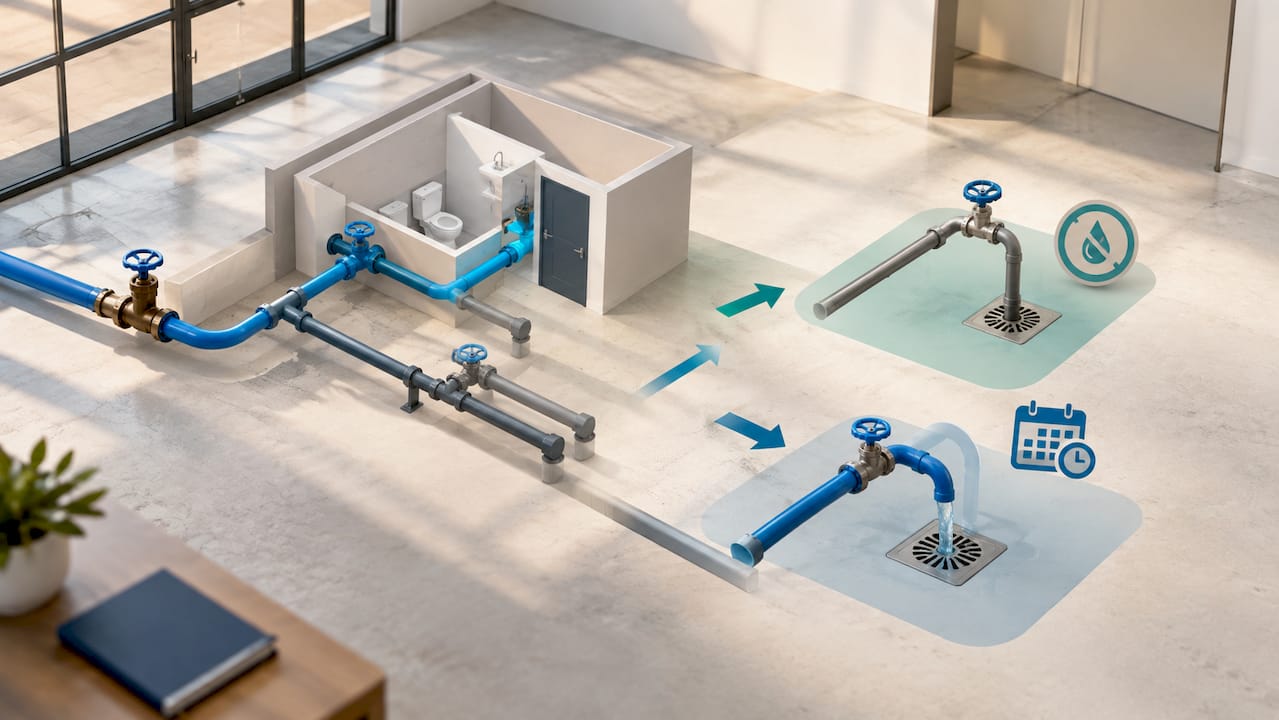
The other retail-specific blind spot is ownership. Multi-let sites often have an unassigned stretch of pipework between the landlord’s riser and the tenant’s first fitting where nobody has formally accepted responsibility. Mapping the system against the lease plan and naming who owns each valve, tank, and riser resolves the gap many retail sites overlook entirely.
Aerosol sources deserve their own line in the assessment, not an afterthought:
Produce misters in grocery and food halls
Decorative fountains and water features in malls
Irrigation lines for planted displays
Cooling towers and evaporative condensers on the roof
Where a permanent fix is available, prioritise it. Removing a dead leg once beats dosing the same problem with biocide every quarter for the next five years.
Building a written control scheme that survives an audit
Your written scheme needs a schematic of every water system, the named responsible person, the control measures in place, the check frequencies, and the remedial process when something fails. Without all five, an inspector will find the gap.
Map the system. A current schematic showing tanks, risers, outlets and ownership boundaries.
Name the competent person. Someone with the training and authority to act, not just a job title.
List the controls and frequencies. Temperature checks, flushing schedules, tank inspections, sampling plans.
Set the remedial pathway. What happens, and who does it, when a check fails.
Review on trigger events. Unit turnover, plant changes or a period of vacancy should all prompt an update to the scheme.
Record type | Minimum retention | Who typically holds it |
Legionella risk assessment | 5 years (5+ employees) | Competent person / dutyholder |
Temperature monitoring logs | 5 years | Facilities team or contractor |
Disinfection and remedial records | 5 years | Contractor plus site file |
Training records | Duration of employment | HR / facilities manager |
Digital logbooks earn their keep here, particularly across estates with heavy tenant churn, where a paper file gets lost the moment a unit changes hands.
How Bespoke Compliance Solutions supports retail clients
Bespoke Compliance Solutions works across retail, healthcare, housing, and commercial property to turn the requirements above into a working system rather than a filing cabinet exercise. Services span Legionella risk assessments, water testing, TMV servicing, automated temperature monitoring, and disinfection works.
The process typically starts with mapping ownership across your site, tenant boundaries included, then building the written control scheme around that map rather than a generic template. Clients receive a site report, a prioritised list of remedial works, a monitoring schedule, and access to ongoing support as the estate changes. One business premises case study shows how that process moves a failing site to a compliant one in practice.
Training requirements and competency standards for staff
The competent person named in your written scheme needs more than a job title; they need documented training covering the biology of Legionella, the specific systems on your site, and what to do when a check fails. HSE guidance under ACoP L8 doesn’t prescribe a single qualification, but it does require evidence that whoever holds the role understands the risks and has the authority to act on them.
For retail sites, that usually means two tiers of training. Facilities and maintenance staff who handle flushing, temperature checks, and TMV inspections need practical, hands-on instruction: how to take a temperature reading correctly, how to flush an outlet without creating an aerosol risk, and how to log what they’ve done so the record actually means something later. Store managers and compliance officers need a broader awareness course covering legal duties, retail-specific risks like void units, and escalation routes when something looks wrong.
Refresher training matters more in retail than in most sectors because staff turnover is high. A competent person who leaves without a handover creates an immediate gap in the written scheme, and a store manager who’s never seen a Legionella awareness session won’t recognise a warning sign until it’s a bigger problem. Legionella Awareness Training delivered on-site or online gives both tiers a documented, dated record of competency, which is exactly what an inspector or auditor will ask to see first.
Training records should sit alongside your monitoring logs, not in a separate HR file that is rarely checked during a compliance review.
What’s the emergency response if contamination is confirmed?
A confirmed positive Legionella result, or a suspected case of Legionnaires’ disease linked to your site, needs an immediate and documented response, not a wait-and-see approach while you gather more data.
The first step is isolation. Take the affected outlet, tank, or system section out of use straight away, and communicate that instruction clearly to staff so nobody reopens it by accident. Next comes disinfection: thermal or chemical treatment appropriate to the finding, carried out by someone competent to do it and recorded in detail, including dates, concentrations or temperatures used, and who signed it off.
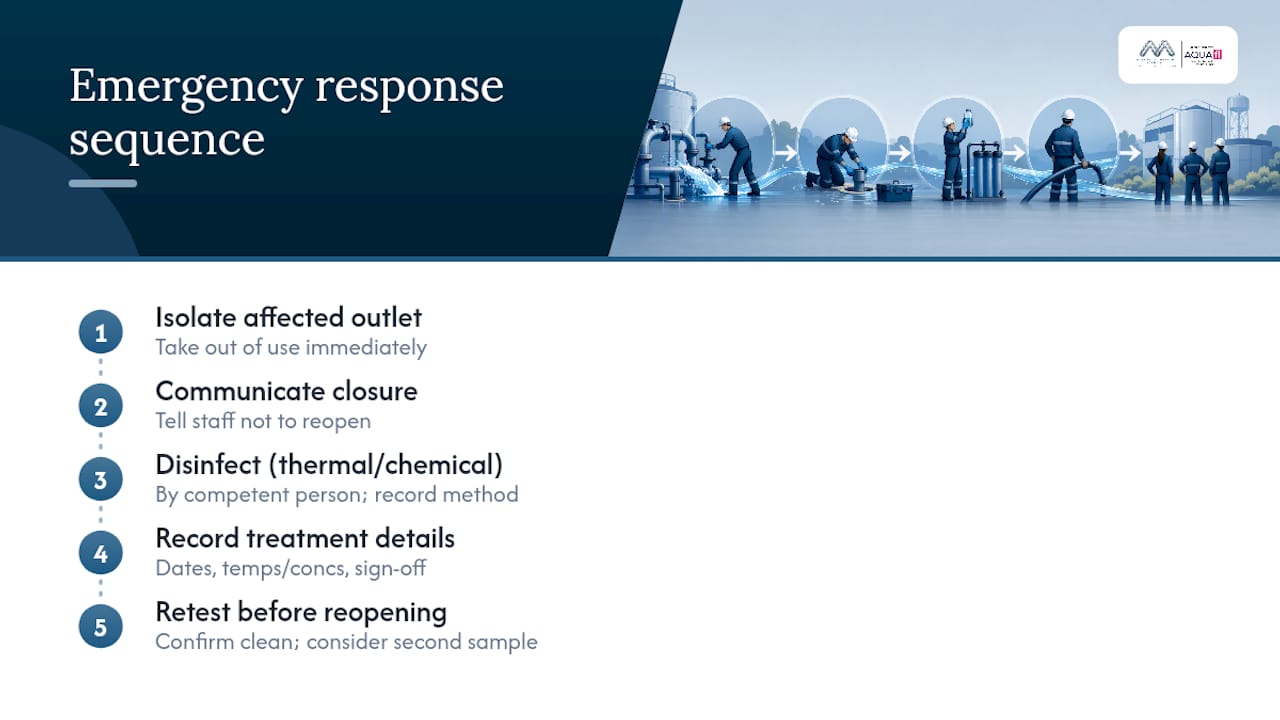
Retesting follows disinfection before anything goes back into service. A single clean result isn’t always enough; risk-based judgement should decide whether a second confirmatory sample is needed before you reopen the outlet to customers or staff.
If a case of Legionnaires’ disease is confirmed or strongly suspected as linked to your premises, notify your local authority and, where employees are affected, consider your RIDDOR reporting duties. Speed matters here: the sooner you isolate the source, the shorter the exposure window for everyone else on site.
Every step needs to land in the written control scheme afterwards. Update the risk assessment, note the trigger event, and record what changed in your controls as a result. An emergency response without a paper trail looks, to an inspector, exactly like no response at all. Remedial works carried out by a competent contractor should always come with a written report you can file against the incident.
How should you communicate water hygiene risks to customers?
Most retail water hygiene work happens invisibly, and that’s the right outcome. Customers shouldn’t need to think about Legionella risk at all, because your controls are working before it becomes a visible problem. But there are moments where clear communication protects both your customers and your business.
Water features, misters, and fountains that are temporarily out of service for maintenance or disinfection should carry simple, non-alarming signage explaining that the feature is offline for routine servicing. There’s no need to reference Legionella by name in customer-facing signage; a generic “temporarily closed for maintenance” notice does the job without creating unnecessary concern.
If an incident does occur that affects customers, such as a confirmed contamination event linked to a water feature or food-prep water supply, your communication needs to be prompt, factual, and coordinated with environmental health if they’re involved. Vague or delayed statements do more reputational damage than an honest, early acknowledgement that a problem was found and fixed.
Internally, coordination between facilities and other departments matters more than most managers assume. Catering and food-prep teams using misting equipment or ice machines need to understand how their equipment fits into the wider water hygiene picture, since a food safety checklist for catering staff often overlaps directly with water hygiene controls around ice, misters, and prep-area taps.
Staff-facing communication should be straightforward too: anyone who might notice a leak, discoloured water, or an unusual smell needs to know who to tell and how quickly. That reporting line is often the first real signal a system’s failing, long before a lab result confirms it.
A brief practitioner perspective: fix the system, then document it
Paperwork alone doesn’t stop an outbreak. I’d rather see a site remove three dead legs than produce a beautifully formatted scheme covering the same faults on repeat. Start with an ownership map and a scheduled flushing programme for void units; those two documents alone close most of the gaps retail sites carry. When you ask for budget, frame it as the cost of one incident against the cost of prevention, because that’s the comparison finance teams actually respond to.
— Sammi
Need help closing the gaps? Here’s what Bespoke Compliance Solutions offers
If reading this has surfaced a gap you can’t close with an in-house team alone, Bespoke Compliance Solutions gives you a route to a fully documented, audit-ready system rather than a partial fix. Where a generic checklist leaves you guessing at frequencies and record formats, a bespoke assessment builds the written control scheme around your actual site, not a template that ignores your void units and tenant boundaries.
[
A typical engagement starts with a site visit to map every tank, riser, and outlet against ownership, followed by a written report identifying priority remedial works. From there, you get a monitoring schedule, recommended temperature monitoring options if manual checks aren’t sustainable across a large estate, and training for whoever holds the competent person role. Testing, TMV servicing, and disinfection work all sit under the same team, so nothing falls through a handover gap between contractors.
If your last risk assessment is out of date, or you’ve never had one, get a Legionella risk assessment booked and start closing the gap before it becomes an inspection finding.
Primary official sources and further reading
This article is general information, not a substitute for advice from a qualified doctor. Consult a qualified healthcare professional about your own circumstances before acting on anything here.
FAQ
Do you legally have to have a Legionella risk assessment?
Yes. ACoP L8 requires every dutyholder to assess Legionella risk and maintain a written control scheme, regardless of business size or building type.
How often should you run a tap to prevent Legionella?
Infrequently used outlets should be flushed at least weekly, and showerheads should be cleaned and descaled at least quarterly.
What are the steps to clean water systems safely?
Practical steps include mapping the system, removing dead legs, controlling temperature above 60°C for storage and below 20°C for cold supply, flushing regularly, disinfecting where needed, and retesting before returning outlets to use. Bespoke Compliance Solutions carries out tank cleaning and system disinfection as part of this process.
Can you tell if water has Legionella just by looking at it?
No. Legionella can’t be detected visually; confirming its presence requires laboratory analysis of a water sample, which is why risk-based sampling forms part of any proper monitoring regime.
Recommended
Comments