
What Inspectors Want on Temperature Noncompliance for UK Dutyholders
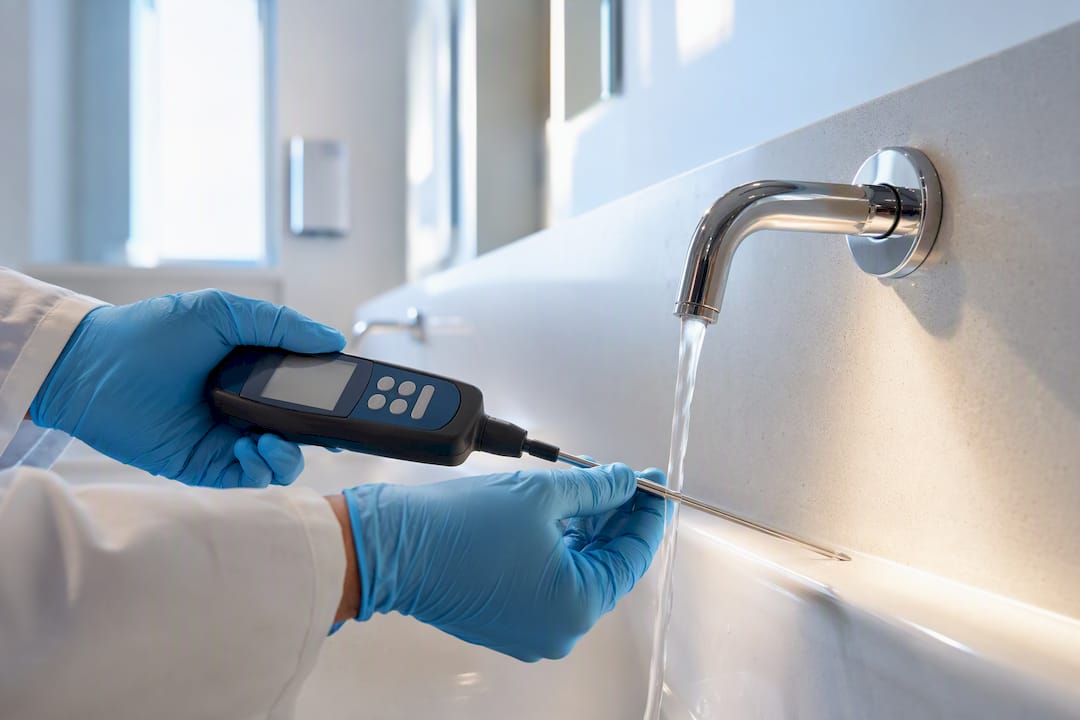
Find a hot or cold outlet outside its target range and your first move is to repeat the check on the same sentinel and an adjacent point, log both readings with the time and date, and start a temporary control such as flushing or raising the calorifier while you notify the responsible person. HSG274 sets the benchmark you’re working against: hot water stored at 60°C, delivered at 50°C within a minute, cold water at 20°C or below. Everything else follows from that first entry in the logbook.
TL;DR:
Confirm that cold water exceeds 20°C within two minutes, or hot water falls below 60°C storage temperature, to meet compliance standards.
Investigate temperature faults immediately on the same day by rechecking outlets, applying controls, and notifying responsible personnel to prevent escalation.
Trace the root cause by inspecting the calorifier, pump operation, TMVs, pipeline routing, stagnation, and recent system changes for persistent issues.
Use targeted remedial actions such as thermal or chemical disinfection, insulation, or operational adjustments based on identified causes, supported by water testing.
Maintain detailed records, including readings, actions, and contractor reports, as well as continuous monitoring, to demonstrate effective control and avoid legal penalties.
Table of Contents
What are the immediate actions for temperature non-compliance?
How do you investigate the root cause of a temperature fault?
What are the legal risks of ignoring temperature non-compliance?
Can you use equivalent controls when temperature targets can’t be met?
How Bespoke Compliance Solutions can help with temperature failures
What are the immediate actions for temperature non-compliance?
The first hour after discovery decides whether an incident stays a minor blip or becomes a documented failure that draws HSE attention. Work through it in order rather than jumping straight to a fix.
Repeat the reading. Check the same sentinel tap again, then test the nearest adjacent outlet. A single anomalous reading can be a faulty thermometer or a momentary draw elsewhere on the system, but two consistent failures confirm a real problem.
Label and isolate. If an outlet is confirmed out of range, especially a cold tap running warm, tag it and place a warning notice for users. Where scalding is the risk on a hot circuit that’s overshooting, restrict access until a thermostatic mixing valve (TMV) check is done.
Apply a temporary control. Flush the outlet for two minutes, divert flow if a deadleg is suspected, or raise the calorifier setpoint slightly if storage temperature has drifted low.
Notify internally. Tell the responsible person, facilities team, and health and safety lead the same day. Persistent or system-wide failures should trigger a call to your water hygiene contractor immediately, not at the next scheduled visit.
Pro Tip: Don’t just flush and move on. Write down what you flushed, for how long, and what the repeat reading showed. That single log entry is often the difference between “isolated fault, quickly resolved” and “unmonitored risk” if an inspector ever asks.
How do you investigate the root cause of a temperature fault?
Fixing the symptom at the outlet without finding the cause almost guarantees the same failure reappears next month. Work backwards from the tap towards the plant.
Check the calorifier. Confirm the actual stored temperature against the gauge, and check the immersion probe or pocket is correctly seated. A probe sitting in a dead zone can read low even when the bulk of the cylinder is hot enough.
Confirm pump operation. A stalled or undersized circulation pump lets water cool in the return loop long before it reaches the tap.
Inspect TMVs. A faulty or wrongly set mixing valve, or an internal bypass, can blend cold water into what should be a 50°C delivery.
Trace the pipe run. Long branches, poor lagging, or pipework routed near unheated voids or cold external walls all lose heat over distance.
Check for stagnation. Warm tank locations, low occupancy, or a room that’s been mothballed since a refurbishment often explain why one branch keeps failing while the rest of the building passes.
Review recent changes. A plant shutdown, a refurbishment, or altered building use can quietly shift a system that used to comply.
Groundwater in the UK typically enters at around 12°C, but surface-fed supplies can climb close to 23°C during a hot summer, which is worth checking before you assume a fault exists on a marginal cold-water reading during a heatwave, as HSG274 Part 2 notes.
What remedial actions fix temperature control violations?
Once you know the cause, match the fix to it rather than defaulting to the most aggressive option available.
Thermal disinfection. Raise the calorifier to a temperature that lets every outlet on the circuit reach 60°C for the disinfection period specified in HSG274 Part 2. This is appropriate for isolated system contamination, but it carries a genuine scald risk, so outlets must be isolated or clearly signed while it runs.
Chemical disinfection. Chlorination or chlorine dioxide dosing is the usual route for wider system contamination or where thermal disinfection isn’t practical. Concentrations and contact times are tightly specified, and this work should go to a trained contractor rather than in-house staff.
Engineering fixes. Re-insulate exposed pipe runs, service or replace a failing TMV, adjust pump timers so circulation runs when the building is occupied, or shorten a deadleg that’s been feeding a redundant outlet.
Operational responses. Increase flushing frequency on affected outlets, step up monitoring on that circuit temporarily, and get contractor scopes of work documented in writing before the job starts, not after.
A detailed water sampling and testing programme alongside these fixes confirms whether the remedial work was actually effective, rather than just assuming it was.
How do you verify a temperature fault has been resolved?
Fixing the fault and closing the incident are two different things. Inspectors want proof, not an assurance.
Resample where risk warrants it. HSG274 guidance uses action levels around 100 and 1,000 CFU/l to judge whether a system needs further disinfection or ongoing enhanced monitoring, so a positive sample after remedial work should trigger a defined response, not a shrug.
Repeat sentinel checks over time. One good reading the day after a repair proves little. Check the same points again over the following one to two weeks to confirm the fix held under normal occupancy patterns.
Watch for persistent variance. If temperatures drift back out of range after a few days, you haven’t fixed the cause, you’ve masked it.
Keep the paperwork inspectors actually ask for. Dated readings, the contractor’s completion report, lab results, and a signed update to the written scheme.
Temperature readings alone don’t guarantee a system is free of Legionella contamination, which is exactly why sampling and monitoring have to work together rather than one substituting for the other.
What are the legal risks of ignoring temperature non-compliance?
Every non-compliance event sits inside a legal framework, whether or not it ever reaches enforcement stage. The duty comes from the Health and Safety at Work etc. Act 1974, and inspectors judge your response against ACOP L8 and HSG274 as the practical benchmark.
Ignored notices escalate. An improvement notice that goes unaddressed can become a prohibition notice, and a pattern of unmanaged failures can lead to prosecution. Under section 37 of the 1974 Act, liability can attach personally to a manager or director where neglect contributed to the breach, not just to the organisation.
Build each log entry around the same fields every time:
Sentinel ID and location
Reading, time and date
Action taken and by whom
Responsible person signing off
Follow-up date and result
Contractor report reference, where applicable
Keep records in both the site logbook and a central digital archive, and retain them for the period your written scheme specifies.
Pro Tip: Most Legionella prosecutions trace back to missing risk assessments or absent monitoring records, not to the presence of bacteria itself. A contemporaneous logbook is your strongest single piece of evidence if HSE ever comes calling.
Can you use equivalent controls when temperature targets can’t be met?
Some buildings genuinely can’t hit 60/50/20, older systems with long historic pipe runs or listed-building constraints being the common culprits. HSG274 and ACOP L8 allow alternative controls, provided you can demonstrate they deliver equivalent protection and you document that case properly.
Acceptable alternatives include:
An enhanced biocide or chemical dosing regime where thermal control isn’t achievable
More frequent, monitored flushing on affected outlets
Increased sampling frequency to compensate for the temperature shortfall
Whatever you choose, the written scheme needs the rationale spelled out, along with performance indicators showing it’s actually working, not just a note that says “alternative control in place.” Ask any contractor doing this work for a detailed remedial report with before and after readings and lab results attached. An automated monitoring system generating continuous logs is increasingly the strongest form of proof available here.
A practitioner’s view on temperature non-compliance
The guidance above reflects patterns seen repeatedly across UK sites: faults trace back to the calorifier or riser far more often than to the outlet itself, so resist the urge to fix the tap and walk away. Keep every case study, contractor report and training record inside the written scheme, not scattered across email threads. And make sure a genuinely competent person holds the role, with refresher awareness training booked before it lapses, not after an inspector asks for the certificate.
— Sammi
How Bespoke Compliance Solutions can help with temperature failures
Bespokecompliancesolutions is the alternative to firefighting temperature failures one outlet at a time. Where DIY flushing and guesswork leave gaps in your evidence trail, a structured service closes them properly, with dated reports an inspector can actually use.
[
If a temperature fault keeps recurring, or you simply want confidence that your written scheme will hold up under scrutiny, Bespokecompliancesolutions offers a full Legionella risk assessment starting from £185, automated water temperature monitoring that captures continuous evidence rather than monthly snapshots, and water tank cleaning and system disinfection when thermal or chemical remediation is needed. TMV servicing and general remedial works are handled through the same compliance services team.
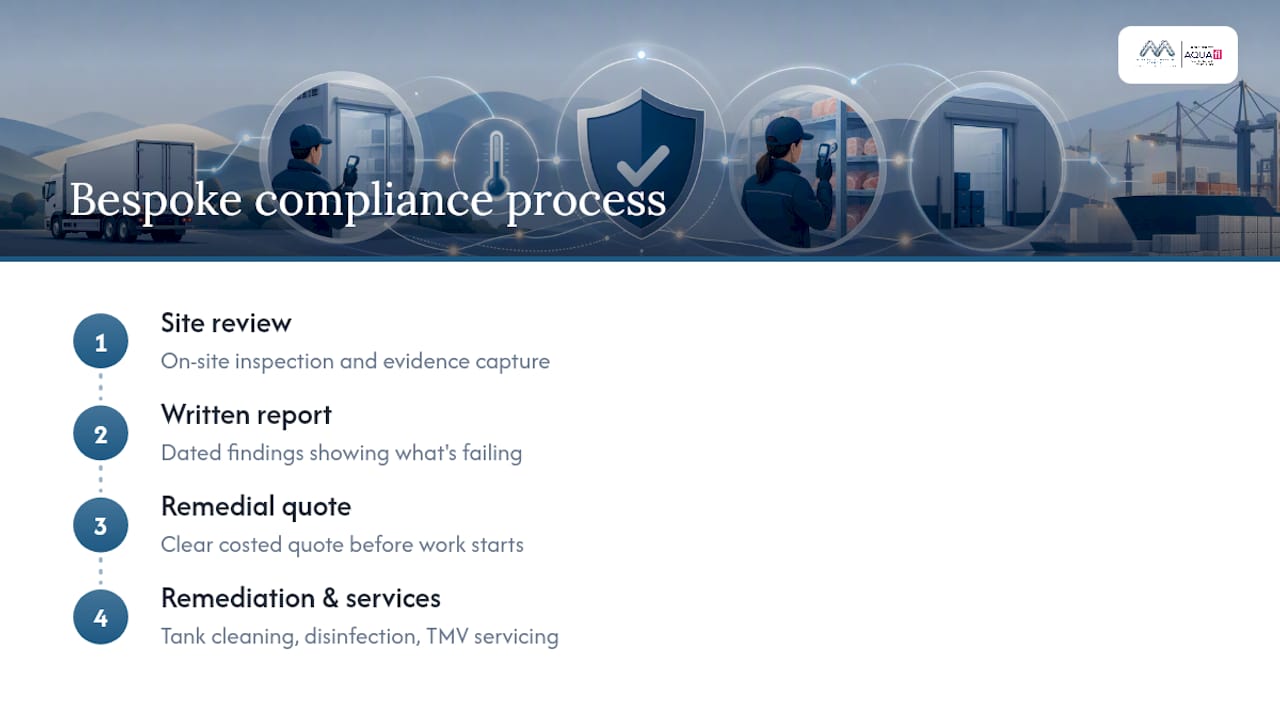
Get in touch and you can expect a site review, a written report setting out exactly what’s failing and why, and a clear remedial quote before any work starts. Book a risk assessment today and get your written scheme back on solid ground.
FAQ
What temperature counts as non-compliant?
Hot water storage below 60°C, hot water not reaching 50°C at the outlet within one minute, or cold water above 20°C within two minutes all count as non-compliant under HSG274.
How quickly must I act on a failed temperature reading?
Investigate the same day: repeat the check, apply a temporary control, and notify the responsible person immediately rather than waiting for a scheduled review.
Do I need to resample for Legionella after a temperature fault?
Resampling is warranted where risk is elevated, guided by HSG274’s action levels around 100 and 1,000 CFU/l, with repeat sentinel temperature checks over the following weeks to confirm the fix held.
What happens if I ignore a temperature non-compliance notice?
Ignored issues can escalate from an improvement notice to a prohibition notice or prosecution under the Health and Safety at Work etc. Act 1974, with liability potentially attaching to individual managers.
How much does a Legionella risk assessment cost?
Legionella risk assessments are available, with current prices and quotes for other services provided after a site review; visit the company website for up-to-date pricing details.
Recommended
Comments