
Why legionella risk varies by season: 2026 guide
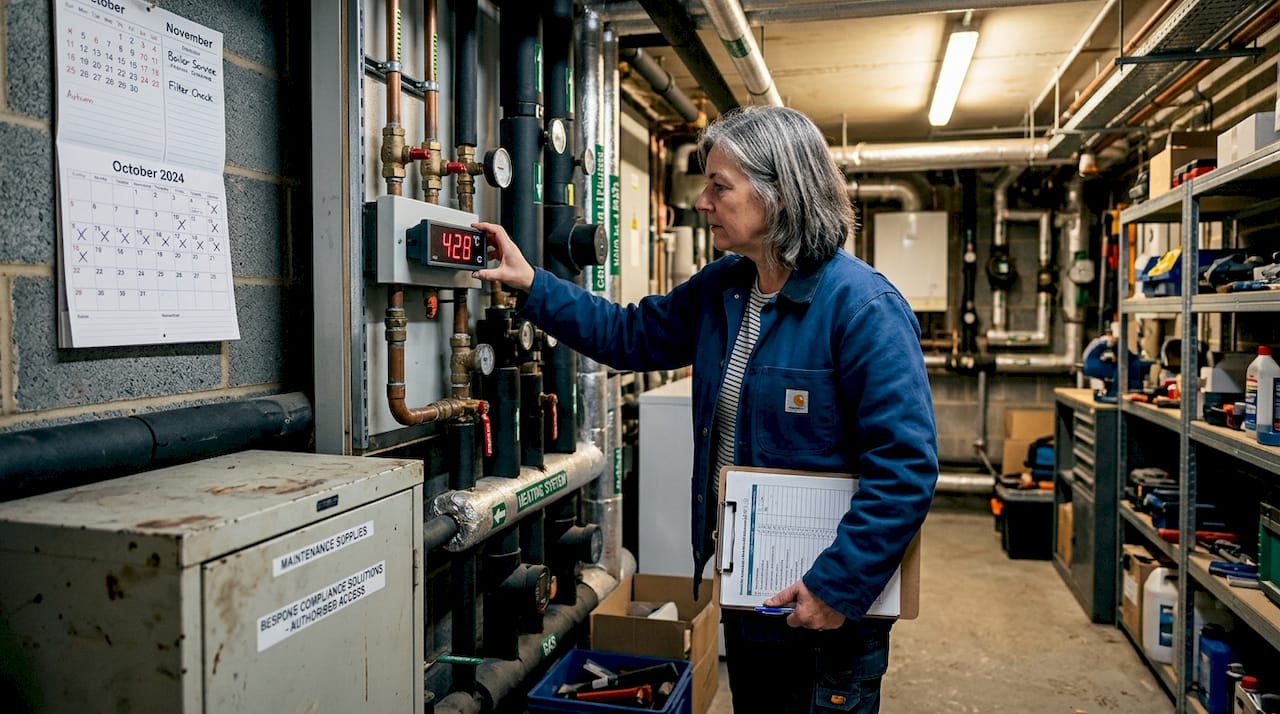
Understanding why legionella risk varies by season is not simply academic. It has direct consequences for how you schedule controls, when you commission assessments, and where you concentrate monitoring effort across the year. Many facilities teams treat Legionella as a summer concern and relax their guard once temperatures drop. The evidence says otherwise. Recent surveillance data from across Europe reveals an autumn peak in community-acquired Legionnaires’ disease cases, a December secondary rise, and lagged climatic effects that mean today’s weather shapes your risk profile weeks from now.
Table of Contents
Key takeaways
Point | Details |
Autumn is the highest-risk period | European surveillance shows Legionnaires’ disease peaks in September, not mid-summer as commonly assumed. |
Temperature effects are delayed by weeks | A 5°C rise above 15°C increases disease incidence with a 9 to 10 week lag, so controls must be proactive, not reactive. |
Rainfall acts faster than temperature | Precipitation influences risk within approximately one week, affecting water age and disinfectant residuals more immediately. |
Seasonal closures create concentrated risk | Buildings left unused over holiday periods or seasonal shutdowns accumulate stagnation conditions that amplify Legionella growth on reopening. |
Climate change is shifting the goalposts | Rising ambient temperatures and altered rainfall patterns are extending risk windows and making facility-specific risk harder to predict from historical patterns alone. |
Why legionella risk varies by season: the science
The misconception that Legionella is purely a hot-weather problem is understandable but costly. Yes, warm temperatures favour bacterial proliferation, but the relationship between climate and disease incidence is far more nuanced than “summer equals danger.”
Data from Italy covering 2005 to 2023 shows a peak-to-trough ratio of 3.62 between the highest and lowest seasonal incidence periods, with the peak falling in autumn rather than the height of summer. That is a nearly fourfold difference in case rates between seasons. The ECDC’s 2022 epidemiological report corroborates this: most European cases occur between June and October, with September representing the single highest month and a secondary cluster appearing in December.
Three climatic variables drive this pattern: temperature, humidity, and precipitation. Each operates on a different timescale.
Climate factor | Effect on Legionella risk | Lag time | Incidence rate ratio |
Temperature rise (5°C above 15°C) | Increases bacterial proliferation within water systems | 9 to 10 weeks | IRR 1.45 (95% CI 1.33 to 1.58) |
Humidity increase | Amplifies environmental transmission risk | 9 to 10 weeks | Correlated with temperature signals |
Precipitation (5 mm above 10 mm) | Affects water age and disinfectant residuals | Approximately 1 week | IRR 1.07 (95% CI 1.06 to 1.09) |
The lag times are the critical insight here. A temperature spike in July does not produce a spike in cases in July. The disease incidence rises roughly 9 to 10 weeks later, which maps precisely onto the September peak seen in surveillance data. Humidity follows the same delayed pattern.
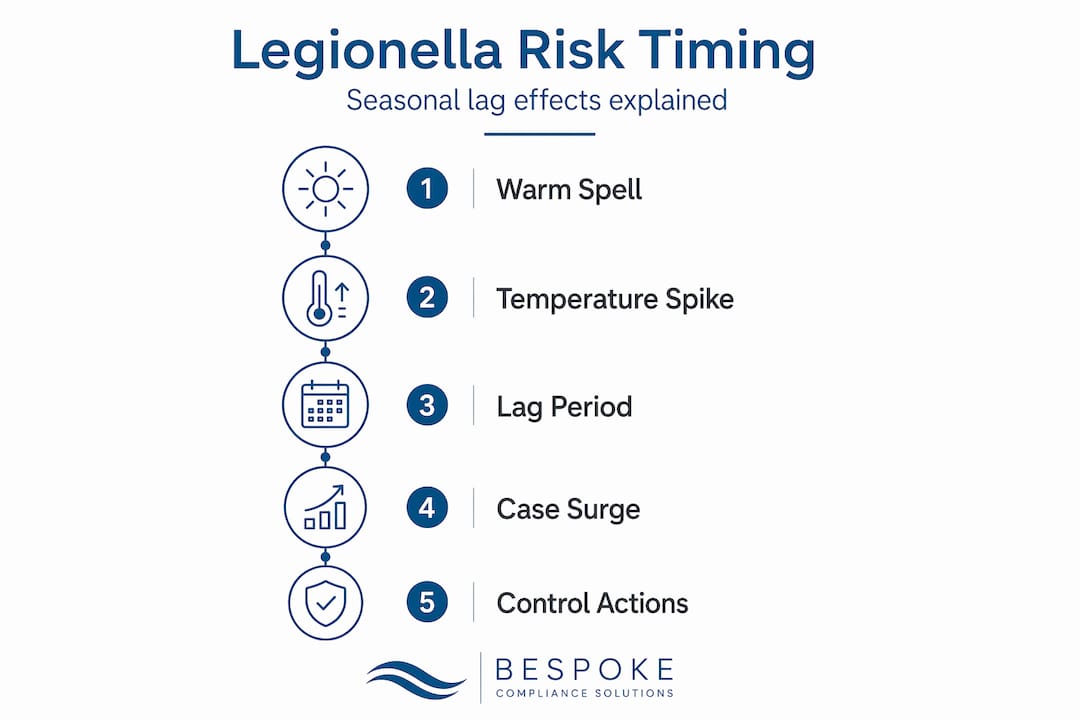
Pro Tip: Mark your calendar from the first sustained warm spell of the year. If temperatures rise significantly above 15°C in June, your elevated-risk window begins in late August, well before the onset of autumn.
Mechanisms inside your water system
The seasonal data reflects what is happening inside your pipes and plant rooms. Legionella growth is favoured by temperatures between 20 and 45°C, combined with biofilm accumulation, scale deposits, and low disinfectant residuals. Seasonal weather shifts do not just affect ambient air. They alter the thermal and hydraulic behaviour of water systems in ways that create or destroy those growth conditions.
Here is how each seasonal legionella risk factor manifests in practice:
Rising ambient temperatures warm incoming cold water supplies and reduce the temperature differential that keeps cold distribution below 20°C, creating a prime growth zone throughout the cold water network.
Biofilm formation accelerates as water temperatures rise, providing Legionella with nutrients and a protected niche that disinfectants struggle to penetrate.
Disinfectant residual decay speeds up in warmer water. Chlorine degrades faster at higher temperatures, meaning the same dosing level that protected your system in March may be inadequate by July.
Reduced water turnover during summer holiday periods, particularly in offices, schools, and universities, increases water age across the distribution system. Stagnant water loses residual disinfectant and accumulates sediment.
Autumn precipitation patterns affect distribution networks more immediately. Heavy rainfall can temporarily dilute disinfectant residuals and alter water quality at the point of entry.
Seasonal closures in educational and commercial premises are a particular concern. Legionella compliance in schools is a recognised challenge precisely because summer shutdowns create extended stagnation across the entire building. The combination of warm ambient temperatures and unused pipework is about as favourable for Legionella as conditions get.
The December secondary peak in surveillance data is instructive here. Heating systems that have been dormant through summer fire up in autumn, warming water in circuits that have sat static for months. Buildings that run reduced occupancy over the Christmas period face similar stagnation risks to those seen in summer.
Pro Tip: Conduct a pre-closure flush and thermal disinfection before any planned shutdown of more than seven days, not just for educational settings but for any facility with prolonged periods of reduced occupancy.
Timing controls to match the lag effects
This is where most compliance programmes fall short. Teams that understand seasonal risk intellectually still schedule their interventions reactively, responding to warm weather rather than anticipating it.
The lagged effects mean that waiting until July to intensify controls is already too late for mitigating the risk that peaks in September. The surveillance data shows water safety actions must be proactive and scheduled weeks ahead of peak incidence, not triggered by it.
The table below sets out a practical scheduling framework aligned with the climatic evidence.
Season | Climatic signal | Action required | Timing |
Late spring (April to May) | Temperatures approaching 15°C | Review and update risk assessment; increase monitoring frequency | 10 to 12 weeks before expected autumn peak |
Early summer (June to July) | Sustained warm spell above 15°C | Intensify temperature monitoring; check disinfectant residuals; pre-closure flushing for buildings entering reduced occupancy | Immediately and ahead of closures |
Late summer to autumn (August to October) | Peak incidence window | Heightened vigilance; post-closure flushing and recommissioning; water sampling | Throughout period |
Autumn to winter (October to December) | Secondary peak; heating recommissioning | Check heating circuits; flush dormant systems; seasonal risk assessment review | Before and immediately after heating season begins |
The contrast between reactive and proactive approaches is stark. A team that commissions a risk assessment in September because it is “Legionella season” is responding to a risk that was seeded by conditions two months earlier. A team that uses the lag data to schedule interventions in June and July is actually doing the work at the right time.
The precipitation signal offers a more immediate but narrower lever. Seasonal rainfall effects on water quality translate into risk changes within about one week. Monitoring disinfectant residuals after significant rainfall events should be built into your operational routines year-round, not just during obvious risk windows.
Climate change and shifting seasonal risk
The seasonal patterns described above are already established. Climate change is now modifying them in ways that make historical baselines less reliable for forward planning.
Rising water temperatures and changing precipitation patterns are altering seasonal risk windows and their magnitude at a facility-specific level. Two premises in the same city can experience different risk trajectories depending on their water system age, configuration, and local microclimate. That is the operational challenge climate change introduces: it undermines generic, calendar-based control programmes.
Several mechanisms are worth understanding. Extended warm periods push the temperature threshold window for cold water contamination across more months of the year. Drought conditions reduce network flow rates, increasing water age and depleting disinfectant residuals in ways that compound the stagnation risk from reduced building occupancy. Conversely, intense rainfall events can simultaneously dilute network chlorine and mobilise biofilm in ageing infrastructure.
The implication for compliance officers is clear. Risk models and monitoring frequencies need to be updated in response to observed climate trends at your site, not just refreshed on a fixed annual cycle. Facilities that have not reviewed their water safety plans in the last two to three years may be operating with assumptions about seasonal risk timing that no longer reflect current conditions. This is particularly relevant for healthcare settings and large commercial campuses where the consequences of an outbreak are severe and the system complexity is high.
My perspective on getting seasonal control right
I have reviewed enough water safety plans to know the most common failure is not ignorance of Legionella. It is assuming that the risk runs on a simple warm-to-cold gradient and scheduling controls accordingly.
The evidence is clear that autumn is the highest-risk period for disease incidence, but the conditions producing that risk were established in early summer. By the time the September peak arrives, the window for preventive intervention has largely closed. What I consistently recommend to facilities managers is to treat the lag data as a planning tool, not just an interesting statistic. Build your control calendar around the 9 to 10 week delay from thermal signal to disease outcome, and you will be ahead of the risk rather than chasing it.
I also want to highlight the underappreciated risk from seasonal closures. Whether it is a university campus over summer, an office building over Christmas, or a hotel in a low season, the combination of warm ambient conditions, reduced water demand, and inactive pipework is reliably dangerous. The guidance on legionella compliance for educational premises makes the point well, but it applies equally across commercial and healthcare settings. Getting pre-closure and post-closure procedures embedded into your operational calendar is one of the highest-value compliance actions you can take.
— Sammi
How Bespokecompliancesolutions can help
Seasonal Legionella risk is not a problem you can address with a single annual assessment. It requires a structured programme aligned with the timing of climatic risk, your building use patterns, and your system-specific vulnerabilities. At Bespokecompliancesolutions, we work with facilities managers and compliance officers across commercial, healthcare, educational, and residential settings to build exactly that.
Our system disinfection and flushing services are specifically designed around seasonal risk windows, including pre-closure and post-closure treatments that address the stagnation risk at the highest-risk points in the year. For year-round visibility, our automated temperature monitoring gives you real-time data on the thermal conditions that feed into Legionella growth, so you can act on early warning signals rather than lag indicators. We also offer bespoke risk assessments, water sampling, and ongoing consultancy tailored to your sites across the UK. Get in touch to discuss a programme built around your seasonal risk profile.
FAQ
When is legionella risk highest during the year?
Surveillance data shows the highest incidence of Legionnaires’ disease occurs in September across Europe, with a secondary cluster in December. The peak reflects temperature and humidity conditions from 9 to 10 weeks earlier, typically June and July.
Why do seasonal closures increase legionella risk?
When buildings sit unused, water stagnates in pipework, disinfectant residuals deplete, and biofilm accumulates. Combined with warm ambient temperatures during summer shutdowns, this creates highly favourable conditions for Legionella growth before the building reopens.
How does rainfall affect legionella risk?
Precipitation increases Legionella disease incidence with approximately a one-week lag, primarily by affecting water age and reducing disinfectant residuals in the distribution network. This effect is more immediate than the longer-lag influence of temperature.
What seasonal legionella risks do university campuses face?
University campuses face concentrated risk during summer closures when buildings are unoccupied for extended periods. Dormant water systems in warm conditions accumulate stagnation risk that must be addressed through thorough flushing and system checks before students return.
How is climate change affecting seasonal legionella patterns?
Climate change is extending warm periods and altering rainfall patterns, which shifts and prolongs seasonal risk windows. Facilities that rely on historical seasonal assumptions for their control programmes may be underestimating current and future risk at their specific sites.
Recommended
Comments