
Why hydrotherapy pools pose a legionella risk
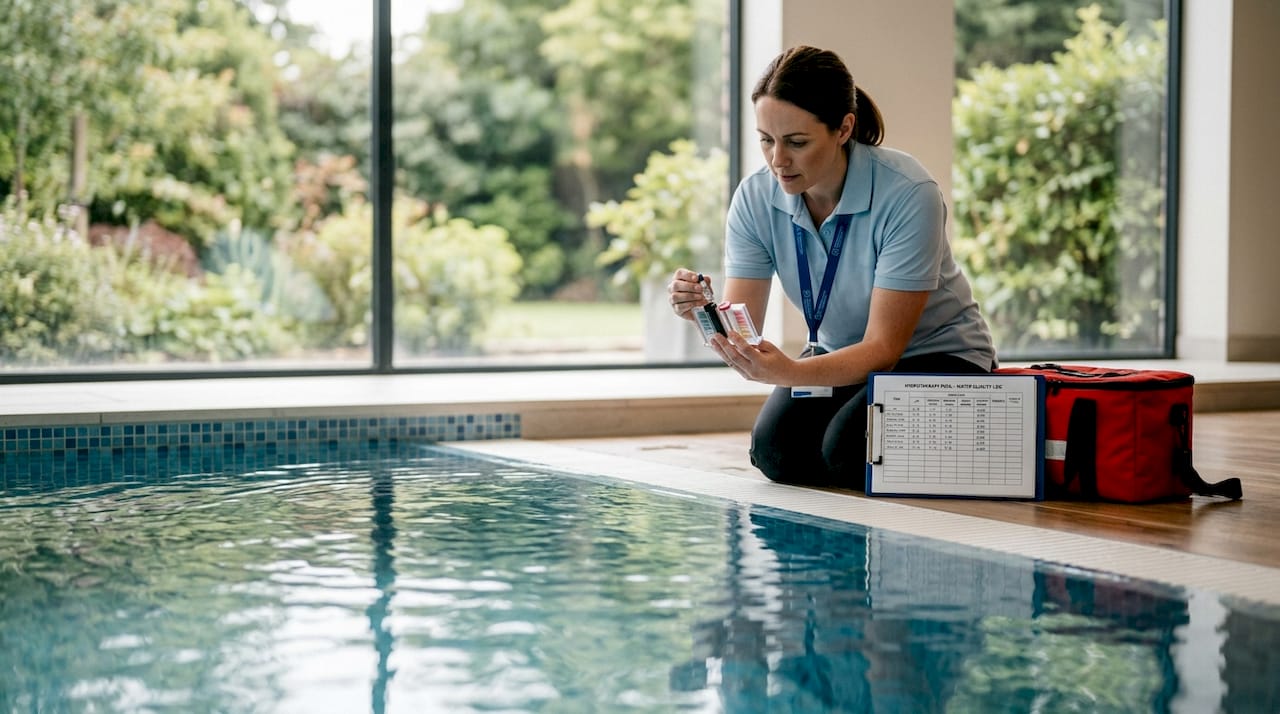
Hydrotherapy pools are among the highest-risk water systems for Legionella proliferation, yet many facilities treat them as a variation of a standard swimming pool. They are not. Understanding why hydrotherapy pools pose a legionella risk requires looking at the specific combination of warm water temperatures, high bather loads, aerosol generation, and complex recirculation systems that make them uniquely dangerous. Legionella pneumophila, the bacterium responsible for Legionnaires’ disease, carries a mortality rate of approximately 10%. For facility managers operating hydrotherapy pools in healthcare or commercial settings, this is not a background risk. It is a live compliance obligation.
Table of Contents
Key takeaways
Point | Details |
Temperature is the core driver | Hydrotherapy pools operate in the 35–40°C range, sitting squarely within Legionella’s optimal growth zone. |
Aerosols reach the breathing zone | Jets and turbulence generate fine droplets that users directly inhale, creating a far greater inhalation risk than standard pools. |
Biofilm undermines chemical control | Standard chlorination cannot penetrate biofilm in pipework; mechanical purging is required to remove the protective layer. |
Vulnerable users face greatest danger | Healthcare hydrotherapy pools serve immunocompromised and elderly patients who face significantly higher mortality if infected. |
Legal duties are non-negotiable | ACOP L8 and the Health and Safety at Work Act 1974 require written schemes, risk assessments, and documented control measures. |
Why hydrotherapy pools pose a legionella risk
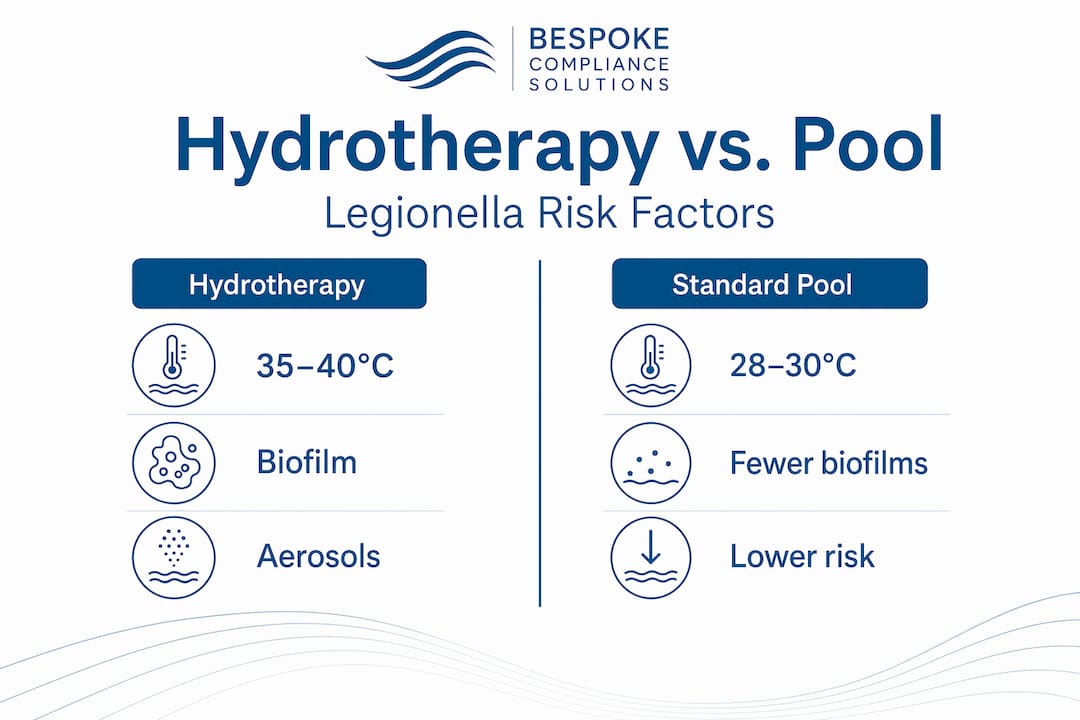
The risks of warm water pools are grounded in biology. Legionella bacteria thrive in warm, nutrient-rich water between 20°C and 45°C. Hydrotherapy pools are deliberately maintained between 35°C and 40°C to maximise therapeutic benefit. That is the precise midpoint of Legionella’s optimal growth range. Unlike a chilled drinking water system or a correctly operated hot water cylinder running above 60°C, a hydrotherapy pool offers no thermal kill mechanism.
The problem compounds quickly. Each bather introduces organic matter into the water: skin cells, body oils, and sweat. This organic loading increases available nutrients, creating a richer growth medium than standard swimming pools. Add constant recirculation through warm pipework and the conditions become progressively more favourable for bacterial colonisation.
What distinguishes hydrotherapy pools from leisure pools is the aerosol risk. Jets and underwater turbulence generate fine droplets directly into the user’s breathing zone. Standard swimming pools are cooler and less turbulent; droplets do not reach the same concentration. In a hydrotherapy pool, a user is effectively breathing in water vapour while submerged at the surface, often for prolonged sessions. This is a fundamentally different exposure route.
Key environmental risk factors include:
Temperature: Sustained operation between 35°C and 40°C places water permanently within the Legionella growth window.
Bather load: High organic input from users accelerates bacterial nutrition and proliferation.
Aerosol generation: Jets and agitation produce fine droplets inhaled directly by pool users.
Recirculation: Warm water cycling continuously through pipes and filters sustains bacterial growth across the entire system.
Session duration: Hydrotherapy sessions are typically longer than recreational swimming, extending inhalation exposure.
Pro Tip: If your hydrotherapy pool temperature is logged but your pipework surface temperatures are not, you are monitoring only part of the system. Recirculation pipes running through warm plant rooms can sustain temperatures just as favourable for Legionella as the pool water itself.
Biofilm and plumbing complexity
Many facility managers are surprised to learn that a visually clean pool with chemically correct water can still harbour significant Legionella risk. The reason is biofilm. Biofilm is a structured community of bacteria encased in a self-produced protective matrix, and it adheres to the interior surfaces of pipes, filters, and jet housings. Standard chlorine levels cannot penetrate this matrix effectively. Chemical shock treatments may kill surface populations but leave the underlying biofilm community intact.
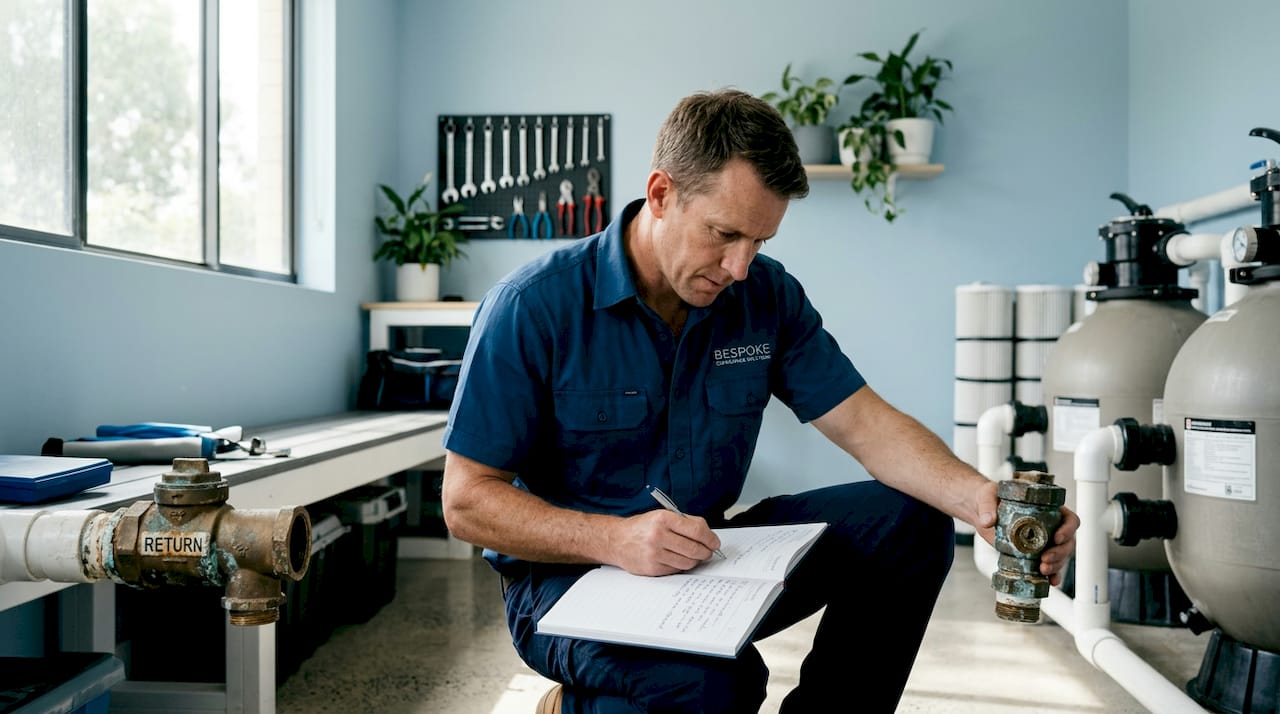
Hydrotherapy pool plumbing is inherently complex. Multiple jets, secondary loops, and dedicated filtration circuits create an extensive network of surfaces where biofilm can establish. Unlike a simple hot water cylinder, there is no single point of control.
The most overlooked risk points in hydrotherapy plumbing are:
Dead legs. These are sections of pipework that branch off the main circuit but carry no regular flow. Water stagnates, temperature drops into the Legionella growth range, and bacterial colonies establish without any sanitising agent reaching them consistently.
Secondary loops. In many healthcare hydrotherapy installations, secondary recirculation loops serve heaters or heat exchangers. These loops may maintain temperatures independently and receive insufficient disinfectant.
Rarely used outlets. Poolside showers and emergency rinse points that are not flushed regularly become reservoirs. Stagnant water in plumbing undermines control even when the main pool chemistry is correctly maintained.
Jet housings and filter media. Biofilm accumulates inside jet bodies and within filter media where water velocity is low and contact time with disinfectant is limited.
Plant room pipework. Exposed pipes in warm plant rooms may sustain elevated temperatures between the pool and the heat source, creating additional colonisation opportunities.
Effective biofilm management requires mechanical purging alongside chemical treatment. Purpose-formulated plumbing purge products, used during planned decommissioning or deep cleans, physically dislodge the biofilm matrix in a way that chemical dosing alone cannot achieve.
Pro Tip: Schedule a full plumbing purge whenever the pool is taken out of service for maintenance. This is the most cost-effective window to address biofilm because the pool is already offline and chemical exposure can be maximised without affecting users.
Legal duties and risks for vulnerable users
Legionnaires’ disease is a severe, and potentially fatal, form of pneumonia caused by inhaling Legionella-contaminated aerosols. Mortality sits at around 10% among infected individuals, and this figure rises significantly for immunocompromised patients, the elderly, and those with chronic respiratory or renal conditions. Healthcare hydrotherapy pools serve precisely these populations.
The Health and Safety at Work Act 1974, combined with the Management of Health and Safety at Work Regulations 1999 and the Approved Code of Practice L8, places a clear legal duty on those responsible for water systems to identify and manage Legionella risk. Hydrotherapy pools fall within scope. The duty holder must commission a documented Legionella risk assessment, produce a written scheme of control, and maintain ongoing records of monitoring, inspection, and remedial actions.
For healthcare premises specifically, NHS HTM 04-01 provides additional technical guidance that supplements ACOP L8. Legionella compliance for healthcare premises carries a higher standard of scrutiny because the consequences of a failure are more severe. A local authority investigation following a Legionnaires’ disease case will examine whether the duty holder had a current, site-specific risk assessment, a written control scheme, and evidence of its implementation.
Statistic: Legionella causes serious illness and death in approximately 10% of diagnosed cases, with higher fatality rates among patients who are elderly or immunosuppressed — the core demographic in healthcare hydrotherapy settings.
Hydrotherapy safety concerns cannot be addressed by generic pool management protocols. The combination of vulnerable users and high-risk water conditions demands a bespoke, documented, and actively managed approach.
Legionella prevention strategies for hydrotherapy pools
Preventing legionella outbreaks in hydrotherapy pools requires more than correct chlorine levels. Effective control operates at the system level, not just at the water surface.
The table below outlines the primary control measures and their specific relevance to hydrotherapy pools:
Control measure | Standard pool | Hydrotherapy pool |
Temperature monitoring | Weekly | Daily or continuous |
Legionella water sampling | Quarterly | Monthly minimum |
Biofilm purge | Annually | Every planned shutdown |
Aerosol risk assessment | Low priority | High priority |
Point-of-use filtration | Rarely required | Recommended in healthcare settings |
Staff training frequency | Annual | Annual with pool-specific refreshers |
Automated temperature monitoring addresses one of the most common compliance failures: the gap between scheduled manual checks. Continuous monitoring systems log water and return temperatures in real time, alerting staff when readings drift outside the control range. This eliminates the risk of an undetected temperature drop creating conditions for bacterial growth between routine inspections.
In healthcare settings, point-of-use filters serve as a critical secondary barrier while systemic remediation work is under way. Fitted at outlets and jet inlets, they physically prevent Legionella-contaminated water from reaching the user even if the upstream system is compromised.
Additional prevention measures include:
Monthly Legionella water sampling with results reviewed against action levels.
Documented flushing routines for all low-use outlets, including poolside showers and emergency rinse points.
Regular inspection and replacement of filter media to prevent biofilm accumulation.
Pool-specific staff training on Legionella covering aerosol risk, temperature control, and the correct response to an adverse test result.
Integration of automated water management across the entire plumbing system rather than point-of-use chemical dosing alone.
Common misconceptions in pool management
Several persistent misunderstandings undermine Legionella control in hydrotherapy pools, and addressing them directly is more useful than repeating standard guidance.
The most consequential misconception is that clear, odourless water is safe water. Visual clarity has no relationship to Legionella counts. A pool can appear pristine while harbouring significant bacterial populations in the recirculation pipework. Legionella is not detectable by sight, smell, or standard turbidity measurements.
A second misunderstanding concerns the transmission route. Many pool operators focus on ingestion risks, such as accidental swallowing of water. Legionella in pools and hydrotherapy environments is primarily an inhalation risk. The aerosol route is the mechanism behind almost all recorded cases of Legionnaires’ disease linked to spa and hydrotherapy environments. Bacteria in hot tubs and hydrotherapy pools reach users through the air they breathe, not through water they swallow.
Other frequently overlooked risk sources include:
Poolside showers that are infrequently flushed and thermally isolated from the main hot water system.
Hose connections and fill points left with residual warm water in the line.
Community access arrangements in schools and special educational needs facilities where user groups rotate and consistent pool management is harder to maintain.
Inadequate cleaning around jet nozzle bodies where biofilm accumulates in the recesses behind the fitting.
Operators who treat hydrotherapy pool maintenance as an extension of standard pool management will consistently underestimate these risks. The two water system types require separate risk frameworks.
My perspective: why standard pool protocols fall short
I have worked with healthcare and commercial facilities where the Legionella control documentation was technically correct, the chlorine levels were in range, and yet the risk remained unacceptably high. The reason, in every case, was biofilm.
What I have learnt is that most facilities manage Legionella at the water surface and neglect the plumbing behind it. Chemical dosing is visible and measurable. Biofilm inside a recirculation loop is neither. It is easy to tick the compliance box when the water sample comes back clear and overlook the fact that a biofilm community inside the pipework can seed the pool water between sampling cycles.
The other lesson I keep returning to is that vulnerability of users changes the risk calculus entirely. In a commercial leisure facility, a healthy adult who contracts a mild Legionella-related illness may recover without hospitalisation. In a healthcare hydrotherapy pool serving cancer patients or post-surgical rehabilitation cases, the same exposure can be fatal. I have seen facilities apply the same monitoring frequency to both settings. That is a misjudgement with serious consequences.
My view is that hydrotherapy pool management should be treated as a specialist discipline within water hygiene, not a subcategory of leisure pool compliance. It requires more frequent sampling, biofilm-specific remediation, continuous temperature logging, and staff who understand the inhalation route, not just pH and chlorine.
— Sammi
How Bespokecompliancesolutions can help
Bespokecompliancesolutions works with healthcare and commercial facility managers across the UK to manage Legionella risk in high-risk water systems, including hydrotherapy pools. If you are responsible for a hydrotherapy facility and need a current, site-specific risk assessment, the team provides Legionella risk assessments in Coventry and the surrounding area, including assessments in Binley and Caludon. Beyond risk assessments, Bespokecompliancesolutions offers water sampling and Legionella testing, implementation of bespoke control programmes, logbook systems, and Legionella awareness training tailored to your team and facility type. Contact Bespokecompliancesolutions for advice specific to your site.
FAQ
What makes hydrotherapy pools riskier than standard swimming pools?
Hydrotherapy pools operate at 35–40°C, generate aerosols directly in the user’s breathing zone, and carry high organic loads from bathers. Standard pools are cooler, less turbulent, and chemically easier to control, making them significantly lower risk for Legionella proliferation.
How often should a hydrotherapy pool be tested for Legionella?
Monthly water sampling is the recommended minimum for hydrotherapy pools, compared to quarterly for standard leisure pools. Healthcare settings with vulnerable users should review sampling frequency as part of their written scheme of control.
Can correct chlorine levels prevent Legionella in hydrotherapy pools?
Not on their own. Chlorine controls planktonic bacteria in the water column but cannot penetrate biofilm in pipework. Mechanical plumbing purges and system-level management are required alongside chemical disinfection for effective control.
Who is legally responsible for Legionella control in a hydrotherapy pool?
Under the Health and Safety at Work Act 1974 and ACOP L8, the duty holder, typically the employer or person in control of the premises, is legally responsible for commissioning a Legionella risk assessment, implementing a written control scheme, and maintaining documented records.
Is hydrotherapy safe for immunocompromised patients?
Hydrotherapy can be safe when the pool is correctly managed and Legionella controls are in place. However, immunocompromised patients face significantly elevated risk if controls fail. Healthcare facilities should follow NHS HTM 04-01 guidance and consider secondary controls such as point-of-use filters as an additional safeguard.
Recommended
Comments